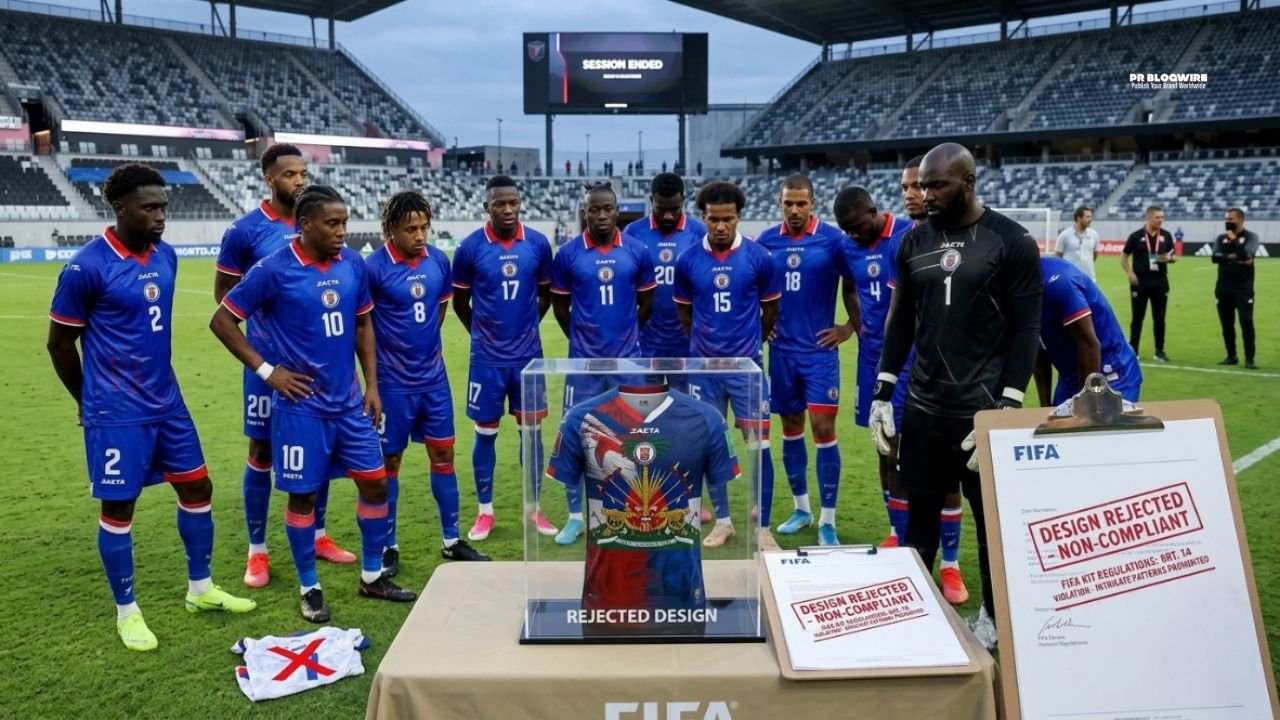
When the Haitian national football team qualified for the 2026 FIFA World Cup, it marked the country’s return to football’s biggest stage after 52 years. But celebration quickly turned to controversy when fans noticed something unusual about the Saeta Haiti jersey designs worn during qualifying matches. Geometric patterns on the kits appeared to resemble sacred Vodou vèvè symbols, igniting a nationwide debate about culture, religion, and whether such imagery could trigger a FIFA Haiti jersey design rejection under the organization’s strict equipment regulations.
Table of Contents
- 1. Haiti’s Historic Return to the World Cup After 52 Years
- 2. The Saeta Haiti Jersey Partnership: A Decade-Long Story
- 3. The Vèvè Symbol Debate: Cultural Pride or Religious Violation?
- 4. FIFA Equipment Regulations: What the Rules Actually Say
- 5. Understanding Haitian Vodou Vèvè Symbols and Their Meaning
- 6. Public Reaction: How Fans, Faith Leaders, and Artists Responded
- 7. Haiti Soccer Jersey Women: The Grenadières’ Growing Legacy
- 8. The Stella Jean Alternative: Fashion Meets Football Heritage
- 9. Custom Haiti Soccer Jersey Options for Fans Worldwide
- 10. What Happens Next? FIFA Approval and the Road to 2026
- Frequently Asked Questions
- Conclusion: More Than Just a Jersey
1. Haiti’s Historic Return to the World Cup After 52 Years
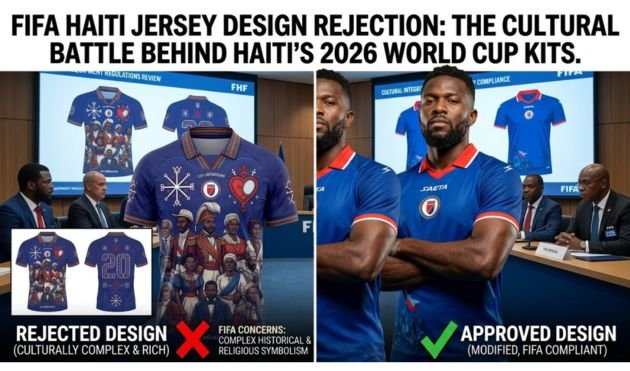
On November 18, 2025, Haiti secured its spot at the 2026 FIFA World Cup with a 2-0 victory over Nicaragua in Curaçao. The date carried profound historical weight, it was the 222nd anniversary of the Battle of Vertières, the decisive conflict that won Haiti’s independence from France in 1803. For a nation battered by gang violence, economic turmoil, and political instability, this qualification represented something far greater than sport. It was a declaration of resilience.
The Haiti soccer team, known affectionately as Les Grenadiers (The Grenadiers), had not appeared on football’s grandest stage since 1974. That debut in West Germany, while ending in three defeats, produced one of the tournament’s most enduring moments when Emmanuel Sanon scored against Italy, becoming the first player to beat legendary goalkeeper Dino Zoff in over two years. The goal put Haiti on the football map, and Sanon’s celebration remains seared into the collective memory of Haitian sports culture.
Head coach Sébastien Migné guided a squad featuring talents like Johny Placide, Duckens Nazon (the team’s all-time leading scorer with 44 goals), and emerging stars Ruben Providence and Louicius Deedson. The team’s qualification journey through CONCACAF qualifying was remarkable not just for the results, but for the circumstances, Haiti has been unable to play home matches since 2021 after gang members overran the Stade Sylvio Cator in Port-au-Prince.
Drawn into Group C for the 2026 tournament alongside Scotland, Brazil, and Morocco, Les Grenadiers face a formidable challenge. Yet for Haitians worldwide, from Port-au-Prince to Brooklyn, Miami to Paris, simply being there represents victory enough. The phrase “Grenadye, alaso” (Grenadiers, to the assault), the team’s centuries-old rally cry derived from revolutionary battle commands, has taken on renewed meaning.
2. The Saeta Haiti Jersey Partnership: A Decade-Long Story
The Saeta Haiti jersey story begins not in a design studio, but in the aftermath of tragedy. In 2010, a devastating earthquake struck Haiti, killing over 200,000 people and reducing much of Port-au-Prince to rubble. Colombian sportswear brand Saeta, then a relatively unknown manufacturer in international football, donated uniform kits to the Haitian Football Federation (FHF). This act of solidarity blossomed into a formal partnership that has now lasted over 15 years.
Saeta’s relationship with Haiti is unique in modern football. While powerhouse nations sign multi-million dollar deals with Nike, Adidas, or Puma, Haiti’s collaboration with the Medellín-based brand has been built on mutual commitment rather commercial scale. Saeta has worked closely with the FHF to, in their words, “create designs that reflect the identity and culture of the country.” Previous kits have drawn from the Haitian coat of arms, natural landscapes, and cultural motifs to produce jerseys that resonate deeply with supporters.
For the saeta Haiti jersey 2026 World Cup collection, the brand unveiled three distinct colorways: a blue home kit, white away kit, and red third kit. Each incorporates the national motto “L’union fait la force” (Union makes strength) and features silhouettes of Haiti’s independence heroes alongside royal palm tree imagery drawn from the national flag. The designs were ambitious, culturally rooted, and unmistakably Haitian.
Then the geometric patterns appeared.
3. The Vèvè Symbol Debate: Cultural Pride or Religious Violation?
As Haiti progressed through World Cup qualifying, sharp-eyed fans began examining the geometric designs adorning the Saeta Haiti jersey kits more closely. Social media users, particularly on TikTok and Instagram, pointed out that the symmetrical patterns bore striking resemblance to vèvè, sacred symbols used in Haitian Vodou ceremonies to invoke spirits known as lwa.
Specifically, many observers identified similarities to Papa Legba’s vèvè, the gatekeeper spirit who stands at the crossroads between the human and spiritual worlds. Papa Legba’s symbol centers on a cross representing the intersection of pathways, with symmetrical elements extending from a central point. The jersey patterns, some claimed, echoed this sacred geometry.
Mambo Zéklè, a Vodou priestess who leads ceremonies at Lakay Sakre in Brooklyn, told The Haitian Times that the designs appeared to reference Papa Legba’s symbol. “If you look at the actual design, both sides of the vèvè, the middle part is blurred out but it’s supposed to represent the gate,” she explained. “Haitian vèvès are always symmetrical, so you have the four directions and then you have each part that intersects like a crossroad in which Legba represents the gatekeeper.”
For practitioners like Mambo Zéklè, the timing deepened the symbolism. Haiti’s qualification occurred during the Gede season in the Vodou calendar, a period dedicated to spirits of the dead and ancestors, and on the anniversary of the Battle of Vertières itself. “My interpretation of this as a Vodouizan is that they are going to be calling on Legba to open all the doors for them,” she said.
Others saw the patterns differently. Saeta has maintained that the designs draw from Haiti’s cultural heritage and natural beauty, incorporating elements inspired by the energy of Haitian carnivals. The FHF has not publicly commented on whether the patterns were intentionally designed to evoke vèvè imagery.
4. FIFA Equipment Regulations: What the Rules Actually Say
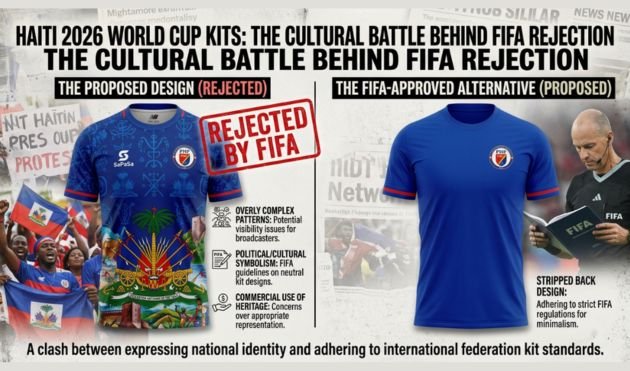
The controversy raised an urgent question: could FIFA actually reject Haiti’s jerseys? The answer lies in Article 4.3.1 of the FIFA Equipment Regulations, which governs what can and cannot appear on national team kits at World Cup tournaments.
Under this provision, teams are explicitly banned from wearing anything featuring political, religious, discriminatory, or personal slogans, images, or statements. This restriction applies comprehensively to all items worn in controlled areas, including jerseys, shorts, socks, and accessories. Team identifiers must avoid political or religious references, and even captain’s armbands require FIFA pre-approval.
The FIFA World Cup 2026 Regulations further reinforce these standards. Article 28 requires all participating member associations to submit complete kit samples for inspection and written approval. Any article deemed non-compliant must be corrected and resubmitted within a specified timeline. Crucially, “any such decisions are not subject to appeal.”
However, the regulations contain an important nuance. Religious clothing worn primarily for faith-based observance, such as head coverings, may be permitted if it meets safety standards and does not display identifying marks or commercial logos. This distinction acknowledges that personal religious expression differs from institutional religious messaging on official equipment.
Whether geometric patterns that resemble religious symbols without explicitly depicting them constitute a violation remains ambiguous. FIFA’s regulations do not specifically address abstract or stylized cultural motifs that may carry religious connotations for those familiar with the tradition. This gray area has fueled debate among football administrators, cultural commentators, and legal experts.
| FIFA Regulation | What It Covers | Implication for Haiti |
|---|---|---|
| Article 4.3.1 | Ban on political, religious, or discriminatory imagery | Explicit vèvè symbols could trigger rejection |
| Article 28.3 | Mandatory FIFA kit inspection and approval | All jerseys must pass review before tournament |
| Article 28.5 | Restrictions on third-party commercial branding | Saeta logos must comply with size limits |
| Article 31.1 | Official FIFA World Cup sleeve badges required | Haiti must incorporate FIFA-mandated patches |
For Haiti, the stakes extend beyond aesthetics. A formal FIFA Haiti jersey design rejection would force last-minute manufacturing changes, disrupt team preparation, and potentially embarrass the federation on the world stage. Saeta and the FHF are walking a careful line, balancing cultural authenticity with regulatory compliance.
5. Understanding Haitian Vodou Vèvè Symbols and Their Meaning
To fully grasp the jersey controversy, one must understand what vèvè actually represents in Haitian culture. Far from the Hollywood caricatures of “voodoo,” Haitian Vodou is a sophisticated spiritual tradition born from the fusion of West African, indigenous Taíno, and European Catholic beliefs. It was Vodou that united enslaved Africans during the revolution that made Haiti the world’s first Black republic in 1804.
Vèvè are intricate cosmograms drawn on the ground during ceremonies using cornmeal, flour, or ash. Each symbol corresponds to a specific lwa (spirit), serving as a visual invocation, a spiritual “telephone number” that calls the deity into the ritual space. According to practitioner sources, the vèvè of Papa Legba, the spirit most associated with the jersey patterns, centers on a cross symbolizing the crossroads between worlds.
Papa Legba occupies a unique position in the Vodou pantheon. As the guardian of gateways and master of communication between humans and spirits, he is always the first lwa honored in any ceremony. No spirit can be reached without his permission. His veve, with its perpendicular axes representing the meeting of pathways, embodies the intersection of material and spiritual realms.
For many Haitians, Vodou is not merely a religion but the foundational ethos of national identity. It was Vodou ceremonies that sparked the 1791 revolution, and Vodou practitioners who formed the backbone of the independence army. When artist and therapist Roy Clement told The Haitian Times that seeing vèvè motifs on an international stage would mean “reclaiming our culture and sense of identity,” he articulated a sentiment shared by millions.
“Vodou is ingrained in Haitian culture, and that’s what gave us our independence,” Clement said. “For it to be shown on such a global stage would be reclaiming what is ours, showing we have pride in our culture, pride in who we are.”
This perspective frames the jersey controversy not as a religious dispute but as an assertion of cultural sovereignty. For a nation too often reduced in international media to poverty and disaster, the World Cup represents an unparalleled opportunity to present Haitian culture on its own terms.
6. Public Reaction: How Fans, Faith Leaders, and Artists Responded
The vèvè jersey debate rapidly transcended sports, becoming a proxy for deeper conversations about Haitian identity in the 21st century. The response revealed a society wrestling with how to honor its roots while navigating modernity and international scrutiny.
Faith leaders largely urged calm and unity. Pastor Malory Laurent of Salvation Church of God in Brooklyn addressed his congregation via TikTok, saying: “We don’t need to fight over whether a shirt does or doesn’t have vèvè symbols. It’s Haitians who will be on the field, not spirits. What matters is supporting the team and remembering we are one people.” His message acknowledged that while Christianity and Vodou have historically been positioned as antagonistic in Haiti, the World Cup offers a moment of transcendent national unity.
Artists and cultural figures tended to embrace the symbolism. Architect and artist Hervé Sabin, speaking from Port-au-Prince, described vèvès as “a form of energy that propels us forward.” Comparing them to blues music, he noted: “Everywhere in the world, people sing the blues to find some kind of energy to get them through the workday. The vèvès aren’t any different.”
Among the general public, opinion split along generational and diaspora lines. Younger Haitians, particularly in the diaspora, largely celebrated the designs as bold statements of cultural pride. Social media users shared side-by-side comparisons of jersey patterns and traditional vèvè drawings, with many expressing hope that FIFA would not interfere. Older, more conservative commentators expressed concern about mixing sacred spiritual imagery with commercial sportswear.
The commercial response was unmistakable. Supporters eager to display national pride rushed to purchase authentic jerseys, clearing inventory within hours. Both men’s and women’s styles sold out rapidly, with only limited pre-sale options remaining available through authorized distributors like Delimart, Saeta’s official Haitian distributor. Authentic jerseys retail for approximately $110, with fan versions priced at $74.
7. Haiti Soccer Jersey Women: The Grenadières’ Growing Legacy
While the men’s team’s World Cup qualification dominated headlines, the Haiti soccer jersey women story deserves equal attention. The Haiti women’s national team, known as Les Grenadières, has established itself as a rising force in Caribbean and CONCACAF football, achieving milestones that parallel and sometimes exceed their male counterparts.
In 2023, Les Grenadières qualified for the FIFA Women’s World Cup for the first time in history, competing in Australia and New Zealand against the world’s best. The achievement signaled Haiti’s emergence as a genuine football nation across both genders, not merely a feel-good underdog story.
Saeta has developed dedicated women’s jersey designs that mirror the men’s aesthetic while accommodating different fit requirements. The 2026 World Cup collection includes women’s fan tops in oversize fits across all three colorways: blue, white, and red. These garments have proven particularly popular among Haitian-American women seeking to express cultural pride through fashion.
Star players like Melchie Dumornay, now shining in European club football, have become role models for a generation of young Haitian girls. The visibility of women’s football, amplified by World Cup participation, is transforming how Haitian society views female athletes. Every haiti soccer jersey women purchase supports not just a team, but a movement toward gender equity in Haitian sports.
8. The Stella Jean Alternative: Fashion Meets Football Heritage
Amid the Saeta vèvè controversy, an entirely different jersey narrative emerged, one that proved artistic vision and cultural respect can coexist beautifully. Italian-Haitian fashion designer Stella Jean, founder of the eponymous Milan-based brand, created a stunning alternative collection that may represent the most elegant football-inspired fashion statement of the 2026 World Cup.
Jean, who had previously designed official uniforms for the Milano Cortina 2026 Winter Olympics opening ceremony, unveiled “L’Haitiana,” a capsule collection of football jerseys conceived as love letters to her ancestral homeland. The designs feature polo-style collars, bold color blocking in Haiti’s signature red and blue, and a poignant detail on the back: the phrase “Lavi a bèl” (Life is beautiful) in Haitian Creole, accompanied by the number 26.
As NSS Sports noted, the Stella Jean collection represents “arguably the most beautiful jersey of the 2026 World Cup” even though it will never appear on the pitch. The collection also includes an elegant women’s dress reimagining the red jersey design, blurring boundaries between sportswear and haute couture.
The Stella Jean example demonstrates that celebrating Haitian culture through football apparel need not be controversial. By foregrounding Haitian Creole language, national colors, and dignified aesthetics rather than potentially divisive religious symbolism, Jean achieved what Saeta’s designs could not: universal praise without regulatory risk.
9. Custom Haiti Soccer Jersey Options for Fans Worldwide
For supporters seeking alternatives to official federation jerseys, the custom Haiti soccer jersey market has expanded dramatically. Haiti’s diaspora, estimated at over 3 million people concentrated in the United States, Canada, France, and the Dominican Republic, represents a significant consumer base hungry for culturally meaningful football apparel.
Several categories of custom haiti soccer jersey options exist:
- Authentic Match Jerseys: The premium $110 version worn by players, featuring technical fabrics with UV protection, moisture-wicking technology, and athletic slim fit. Currently produced by Saeta in Colombia.
- Fan Replica Jerseys: The $74 supporter version using lighter materials with a more relaxed fit, ideal for casual wear and match viewing.
- Customized Name/Number Options: Many retailers offer personalization services allowing fans to add names and numbers, though official federation jerseys maintain strict branding controls.
- Diaspora-Designed Alternatives: Independent Haitian-American designers have created unofficial jerseys that blend football aesthetics with streetwear sensibilities, often selling through social media and online marketplaces.
When purchasing haiti soccer team jersey merchandise, buyers should verify authenticity through official channels like Saeta’s official store or authorized distributors. Counterfeit jerseys flood the market during World Cup years, and purchasing fakes undermines both the federation’s revenue and the artisans producing legitimate products.
For those seeking something beyond standard replicas, the Stella Jean collection offers a compelling premium option, though availability is limited and pricing reflects its designer status. Regardless of choice, every jersey purchased ahead of the 2026 tournament contributes to a historic moment: Haiti’s return to football’s global center stage.
10. What Happens Next? FIFA Approval and the Road to 2026
As of early 2026, Haiti awaits final FIFA approval for its official World Cup kits. The timeline is tight: approved uniforms are typically confirmed between March and April ahead of summer tournaments. Should FIFA determine that the Saeta designs violate Article 4.3.1, the federation would face an unenviable choice: redesign hastily or risk playing in generic, culturally disconnected kits.
Most football kit experts believe a complete rejection is unlikely. The patterns in question are stylized and abstract enough to plausibly deny direct vèvè representation. FIFA has historically shown leniency toward culturally significant designs that do not explicitly promote religious doctrine. The organization’s concern focuses primarily on political statements and discriminatory messaging rather than abstract cultural references.
However, the controversy itself has already shaped the narrative around Haiti’s World Cup participation. Whether the designs are approved or modified, the conversation has elevated global awareness of Haitian culture, Vodou spirituality, and the complex intersection of national identity with international sport.
For the haiti soccer jersey world cup story to have a happy ending, all parties, Saeta, the FHF, and FIFA, must find common ground that honors Haiti’s heritage without violating established regulations. The world will be watching.
Key Takeaways: The FIFA Haiti Jersey Design Controversy
- Haiti’s 2026 World Cup qualification ended a 52-year absence from the tournament, sparking nationwide celebration.
- Saeta’s jersey designs feature geometric patterns that some observers believe resemble sacred Vodou vèvè symbols, particularly Papa Legba’s crossroads symbol.
- FIFA Article 4.3.1 prohibits political, religious, or discriminatory imagery on official kits, creating potential regulatory conflict.
- Public opinion is divided between those who view the designs as proud cultural expression and those concerned about mixing sacred symbolism with commercial sport.
- Alternatives like Stella Jean’s L’Haitiana collection demonstrate that cultural celebration can succeed without controversy.
- Fans seeking haiti soccer jersey women or men’s options should purchase through authorized channels to ensure authenticity.
- The final FIFA decision is expected by April 2026, with most experts predicting approval or minor modifications rather than outright rejection.
Frequently Asked Questions
Why did FIFA potentially reject Haiti’s jersey design?
FIFA’s equipment regulations prohibit religious imagery on official kits. The geometric patterns on Haiti’s Saeta jerseys resemble vèvè symbols used in Vodou ceremonies, which could violate Article 4.3.1. However, no formal rejection has occurred; the designs remain under review pending FIFA’s final approval process expected in early 2026.
What are vèvè symbols and why are they controversial on a football jersey?
Vèvè are sacred cosmograms drawn during Haitian Vodou ceremonies to invoke spirits called lwa. Each symbol corresponds to a specific deity. Their appearance on commercial sportswear is controversial because Vodou practitioners consider them sacred religious imagery, while some Christian Haitians oppose their public display. FIFA’s regulations also restrict religious symbols on official equipment.
Who designed Haiti’s 2026 World Cup jerseys?
Colombian sportswear brand Saeta designed Haiti’s official 2026 World Cup kits. Saeta has partnered with the Haitian Football Federation since 2010, when the company donated uniforms following the devastating earthquake. The 2026 collection features three colorways: blue (home), white (away), and red (third).
Where can I buy authentic Haiti soccer jerseys for the 2026 World Cup?
Authentic saeta Haiti jersey 2026 products are available through Saeta’s official website and authorized distributors like Delimart in Haiti. Authentic match jerseys retail for approximately $110, while fan versions cost around $74. Be cautious of counterfeit products on unofficial marketplaces.
Does Haiti have a women’s national soccer team jersey?
Yes, the Haiti women’s national team, known as Les Grenadières, has dedicated jersey designs through Saeta. The 2026 collection includes women’s fan tops in oversize fits across all three national colors. Les Grenadières made history by qualifying for their first FIFA Women’s World Cup in 2023.
What makes the Stella Jean Haiti collection different from Saeta’s official jerseys?
Italian-Haitian designer Stella Jean created the L’Haitiana collection as a fashion-forward alternative to official match kits. Featuring polo-style collars, Haitian Creole phrases, and elegant tailoring, these jerseys prioritize cultural sophistication over athletic performance. They are not approved for on-pitch use but have been widely praised for their artistic merit.
When will FIFA make a final decision on Haiti’s World Cup kits?
FIFA typically completes kit approvals between March and April ahead of summer World Cup tournaments. The 2026 edition kicks off in June across the United States, Canada, and Mexico. Haiti fans should expect final confirmation of approved designs by early spring 2026.
Conclusion: More Than Just a Jersey
The FIFA Haiti jersey design rejection controversy transcends football regulation. It is a story about how a nation of 11 million people, scattered by migration and battered by circumstance, seeks to define itself on the world stage. For Haiti, the 2026 World Cup is not merely a sporting event, it is an opportunity to reintroduce itself to a world that too often sees only its struggles.
Whether the Saeta jerseys receive FIFA approval or require modification, the conversation they sparked has already served its purpose. It forced a global audience to learn about vèvè, to grapple with Vodou’s profound role in Haitian identity, and to recognize that football jerseys can carry cultural weight far exceeding their functional purpose.
For fans searching for the perfect haiti soccer jersey world cup collectible, the options have never been richer. From Saeta’s officially licensed match kits to Stella Jean’s fashion-forward alternatives to custom Haiti soccer jersey creations from independent designers, there is a way for every Haitian, and every friend of Haiti, to wear their pride.
As Les Grenadiers prepare to face Brazil, Scotland, and Morocco on football’s grandest stage, they will carry more than tactical instructions and national expectations. They will carry the weight of history, the resilience of a revolutionary people, and the hope that 2026 represents not just a return to the World Cup, but a rebirth of how the world sees Haiti.
Grenadye, alaso. The gates are opening.
Sources and References
- The Haitian Times – “Vèvè-like patterns in Haiti’s Saeta kit spark cultural debate ahead of World Cup” (December 6, 2025)
- FIFA Official – “Haiti at the FIFA World Cup: Team profile and history” (March 26, 2026)
- FIFA World Cup 2026 Regulations (Official Document)
- Footy Headlines – “Haiti 2026 World Cup Home, Away & Third Kits Released” (April 2, 2026)
- NSS Sports – “The most beautiful jerseys of the 2026 World Cup belong to Haiti” (May 29, 2026)
- Wikipedia – Haiti National Football Team
- Wikipedia – Haiti at the FIFA World Cup
- Sportsnet – “Haiti qualifies for first World Cup since 1974” (November 19, 2025)
- Erzulie’s Voodoo – “Vodou Lwa Papa Legba”
- Visit Haiti – “A Visual Guide to Vèvè: Vodou Symbols & Cosmograms”
- The 509 Craft – “Haiti Football: The Deep History and Burning Passion Behind Les Grenadiers” (March 22, 2026)
- The Haitian Times – “Why ‘Grenadye, alaso’ is Haiti’s World Cup rally cry” (November 22, 2025)
- Footy Headlines – “FIFA 2025 Kit Element Rules” (February 16, 2025)