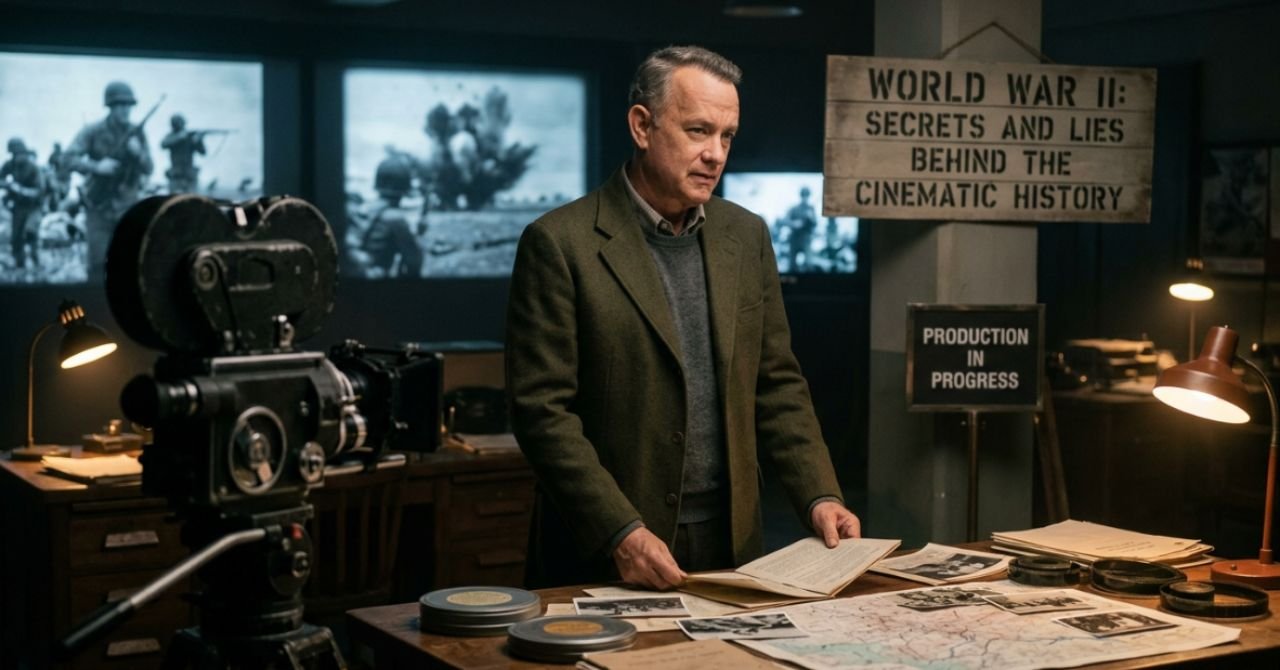
However, the intersection of Hollywood storytelling and historical reality is rarely a simple mirror image. Behind the cinematic triumphs, the stellar set designs, and the deeply moving orchestral scores lies a complex web of omitted truths, narrative shortcuts, and calculated myth-making. Every historical production must constantly balance the rigorous demands of factual accuracy with the structural requirements of dramatic tension. In this deep dive, we explore the intricate tapestry of World War II with Tom Hanks, uncovering the secrets, the historical discrepancies, and the hidden complexities behind his most iconic projects.
The Cinematic Architect of Modern Memory
To understand the profound impact of Tom Hanks’ World War II portfolio, one must first recognize the sheer scale of his contributions. It is not merely about individual acting credits; it is about a sustained, multi-decade effort to preserve and interpret history. Alongside legendary director Steven Spielberg, Hanks transformed the landscape of historical media, establishing a production ecosystem that prioritized granular visual realism, deep archival research, and an intense focus on the psychological experiences of everyday soldiers.
This journey fundamentally altered how the public engages with the past. Before this era, cinematic depictions of World War II often leaned into idealized, heavily sanitized Golden Age Hollywood tropes or grand, detached strategic overviews like The Longest Day. The collaboration between Hanks and Spielberg shifted the perspective entirely, dropping the audience directly into the mud, noise, and chaos of the frontlines. This stylistic pivot did not just win awards; it set a new benchmark for historical realism that every subsequent production has had to reckon with.
The Major Works: A Living Timeline
The Hanks-Spielberg World War II universe is built upon several monumental pillars, each focusing on a distinct branch of the military and a unique theater of operation:
- Saving Private Ryan (1998): The definitive cinematic depiction of the D-Day landings and the brutal infantry combat of the European theater.
- Band of Brothers (2001): An eleven-time Emmy Award-winning miniseries tracking Easy Company, 506th Parachute Infantry Regiment, 101st Airborne Division, from training to the capture of the Eagle’s Nest.
- The Pacific (2010): A gritty, unflinching look at the brutal island-hopping campaigns endured by the 1st Marine Division, highlighting the psychological toll of jungle warfare.
- Greyhound (2020): A tense, claustrophobic naval thriller written by and starring Hanks, focusing on the relentless Battle of the Atlantic and the defense of allied merchant convoys.
- Masters of the Air (2024): A sweeping epic chronicling the devastating strategic bombing campaigns conducted by the “Bloody Hundredth” of the U.S. Army Air Forces over occupied Europe.
Saving Private Ryan: The Shock of Reality vs. The Fiction of the Mission
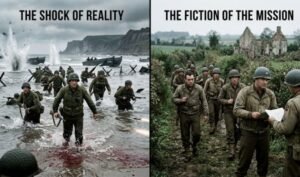
When Saving Private Ryan debuted in theaters in 1998, it shocked audiences and veterans alike. The opening twenty-four minutes, depicting the landing of the 29th and 1st Infantry Divisions at Omaha Beach, were praised for their terrifying, uncompromising realism. Combat veterans from across the globe reported that the film accurately captured the disorienting noise, the sudden violence, and the sheer terror of that June morning. The production went to extraordinary lengths, using actual amputees for gory sequences and deploying period-accurate landing craft to achieve unparalleled visual authenticity.
Yet, once Captain John Miller (played by Hanks) and his men move off the beach and into the French countryside, the film transitions from raw historical recreation into a highly stylized, fictionalized narrative. The central premise—a dedicated squad sent deep into enemy territory specifically to rescue a single paratrooper whose brothers had been killed in action—is a dramatic interpretation of historical events rather than a strict factual record.
The True Story: The Niland Brothers
The screenplay, written by Robert Rodat, was inspired by the real-life story of the Niland brothers. Technical Sergeant Edward Niland, Second Lieutenant Preston Niland, Technical Sergeant Robert Niland, and Sergeant Fritz Niland were four American brothers serving in different units during the war. When reports arrived that three of the brothers were dead or missing in action, the War Department enacted the Sole Survivor Policy to protect the remaining sibling.
Historical Fact Check: Unlike the movie, there was no desperate, combat-heavy search party led by a shell-shocked captain to find Fritz Niland. Instead, once the War Department realized the tragic situation, administrative orders were sent through standard channels. Fritz Niland was located at his unit, safely removed from the front lines, and shipped back to the United States to serve out the remainder of the war as a MP in New York.
By transforming an administrative recall into a high-stakes combat operation, the film successfully explores profound ethical questions regarding the value of a single human life against the backdrop of total war. However, it creates a romanticized myth about the lengths to which the military high command would go for an individual soldier during an active, chaotic invasion.
Band of Brothers: The Complexity of Memory and Eyewitness Testimony
Based on the acclaimed non-fiction book by historian Stephen E. Ambrose, Band of Brothers is widely regarded as one of the greatest achievements in television history. By focusing heavily on the real-world accounts of Easy Company veterans, the series achieved an astonishing level of emotional intimacy. The decision to preface episodes with interviews with the surviving veterans created an unbreakable bond of trust with the audience, establishing the series as an authoritative historical document.
Despite its legendary status, historians and researchers have noted that the series occasionally stumbles by relying too heavily on unverified eyewitness memories, which can naturally blur, fade, or distort over fifty years.
The Controversy of Albert Blithe
One of the most striking narrative choices occurs in Episode 3, “Carentan,” which focuses extensively on Private Albert Blithe (portrayed by Marc Warren). The episode portrays Blithe struggling with severe psychological blindness brought on by combat stress, eventually overcoming his fear to fight bravely, only to be shot in the neck by a sniper days later. The episode concludes with a somber text crawl stating that Blithe never recovered from his wounds and died in 1948.
This statement was entirely incorrect. In reality, Albert Blithe did not die in 1948. While he was severely wounded in the neck in France, he recovered fully, remained in the Army, and went on to live a distinguished military career. He fought in the Korean War with the 187th Airborne Regimental Combat Team, earned a Silver Star and a Bronze Star for valor, was promoted to Master Sergeant, and ultimately passed away while on active duty in Germany in 1967.
The mistake occurred because the veterans of Easy Company, who assisted Ambrose with his research in the late 1980s and early 1990s, had genuinely lost touch with Blithe after the war and mistakenly believed he had died of his wounds. Because the production team relied exclusively on oral history without cross-referencing official military records or reaching out to Blithe’s surviving family, a highly inaccurate version of a real soldier’s life was broadcast to millions of viewers worldwide.
The Characterization of Captain Herbert Sobel
Another area where Band of Brothers faces scrutiny from serious military historians is its highly polarized portrayal of Captain Herbert Sobel (played by David Schwimmer). The series positions Sobel as a tyrannical, incompetent martinet who was universally despised by his men and utterly incapable of navigating tactical field exercises.
While Sobel was undoubtedly a strict, deeply unpopular disciplinarian, many veterans—including those featured heavily in the series—later admitted that his brutal, unforgiving physical training regimen at Camp Toccoa was precisely the reason Easy Company survived the horrors of Normandy and the Ardennes. By framing Sobel purely as an antagonist to highlight the heroic rise of Richard Winters, the series leans into a classic Hollywood good-vs-evil narrative structure, flattening the complex realities of military leadership and training dynamics.
The Pacific: Confronting the Unfiltered Horror of the Jungle
Following the massive success of Band of Brothers, Hanks and Spielberg turned their attention to the Asia-Pacific Theater with 2010’s The Pacific. Drawing primary source material from the memoirs of legendary Marines Robert Leckie (Helmet for My Pillow) and Eugene Sledge (With the Old Breed), this series intentionally broke away from the traditional, inspiring “triumphant narrative” of the European war.
Instead, The Pacific focused heavily on the brutal, dehumanizing nature of the island-hopping campaign. It tackled difficult themes head-on: the horrific tropical diseases, the psychological disintegration of soldiers, the execution of prisoners, the mutilation of dead bodies for gold teeth, and the absolute absence of chivalry on both sides. It was dark, deeply unsettling, and radically adjusted the cultural understanding of what American forces endured in places like Guadalcanal, Peleliu, and Okinawa.
| Cinematic Element | Hollywood Interpretation | Historical Reality |
|---|---|---|
| Combat Continuity | Portrays continuous, high-octane battles flowing seamlessly from one ridge line to the next. | Combat was defined by long periods of agonizing boredom, logistical failures, heat exhaustion, and sudden ambushes. |
| Tactical Decisions | Focuses on the immediate choices made by infantry squads trying to survive localized firefights. | Many islands (especially Peleliu) involved massive strategic miscalculations by high commands who underestimated Japanese cave fortifications. |
| Enemy Depiction | Often frames the Japanese soldiers as a shadowy, faceless, almost supernatural force of nature. | The Imperial Japanese Army operated under a deeply entrenched, highly organized ideological framework centered around the Senjinjunketsu (Military Code). |
While The Pacific is celebrated for its uncompromising dedication to showing the raw psychological trauma of war, it occasionally compresses timelines and blends historical figures together to maintain a coherent narrative flow across ten episodes. For example, the complex domestic struggles of legendary Medal of Honor recipient John Basilone are heavily streamlined to fit neatly into the Hollywood structure of a tragic home-front romance, glossing over his extensive, grueling public relations tours for war bonds.
Greyhound and Masters of the Air: Technology, Tactics, and Omissions
Tom Hanks’ recent forays into World War II history—the 2020 film Greyhound and the 2024 Apple TV+ miniseries Masters of the Air—showcase a profound fascination with the highly technical, mechanized aspects of modern industrial warfare. Both productions utilize cutting-edge digital visual effects to recreate environments that are impossible to capture practically today: the violent, frozen swells of the mid-Atlantic gap and the sub-zero, oxygen-depleted skies over Germany.
Greyhound: The Lethal Physics of Anti-Submarine Warfare
In Greyhound, adapted from C.S. Forester’s novel The Good Shepherd, Hanks plays Commander Ernest Krause, a career naval officer guiding an international convoy escort through the perilous “Black Pit”—the vast mid-Atlantic region completely beyond the reach of allied land-based air cover. The film is a masterclass in naval procedures, filled with rapid-fire commands regarding rudder angles, sonar pings, and depth charge patterns.
Where the film intentionally diverges from reality is in its highly dramatic representation of German U-boats. In the movie, the U-boat captains use their radios to broadcast eerie, mocking taunts directly onto the allied convoy’s radio frequencies, howling like wolves to psychologically terrorize the crew.
In the actual Battle of the Atlantic, this simply never happened. U-boat operations relied entirely on absolute stealth, strict radio silence, and disciplined execution. Broadcasting taunts over the radio would have compromised their exact positions to allied High-Frequency Direction Finding (HF/DF or “Huff-Duff”) equipment, leading to swift destruction. This cinematic embellishment was added to give a faceless, underwater enemy a distinct voice and personality, creating an immediate, visceral antagonist for the audience to fear.
Masters of the Air: The Grim Arithmetic of the Eighth Air Force
With Masters of the Air, Hanks and Spielberg tackled the immense, terrifying story of the Eighth Air Force’s strategic bombing campaign against Nazi Germany. The production accurately captures the horrifying conditions inside the unpressurized, freezing B-17 Flying Fortresses, where a single piece of flak or an enemy fighter cannon could instantly vaporize a crew member or slice an aircraft in half.
The series excels at illustrating the shifting tactical landscape of the air war, particularly the arrival of the P-51 Mustang with drop tanks, which finally provided the bombers with long-range fighter escorts and turned the tide of the conflict. However, due to its tight focus on the pilots of the 100th Bomb Group, the series naturally sidesteps some of the larger, highly controversial geopolitical debates surrounding the Allied bombing strategy.
For instance, the bitter, ongoing strategic division between the U.S. Army Air Forces (who advocated for precise, daylight precision bombing of military targets) and the British Royal Air Force (who championed nighttime area bombing aimed at dehousing civilians and breaking morale) is downplayed. By focusing primarily on the survival, capture, and escape of specific pilots, the narrative isolates the viewer from the devastating, complicated humanitarian realities on the ground in cities like Hamburg and Dresden.
The Cultural Impact: Shaping the “Greatest Generation” Narrative
The cumulative effect of Tom Hanks’ extensive body of work extends far beyond entertainment metrics or box office returns. His productions have played a foundational role in defining the cultural memory of World War II for late-twentieth and early-twenty-first-century generations. This specific lens of historical storytelling has deeply influenced how society views patriotism, duty, sacrifice, and the trauma of war.
The Rise of Tom Hanks as a Public Historian
Hanks’ commitment to the history of the conflict is deeply genuine, extending well past his creative output. He served as a principal national spokesperson for the campaign to construct the National World War II Memorial in Washington, D.C., helping to raise millions of dollars to ensure the veterans of the conflict were honored nationally. Furthermore, his close relationship with the The National WWII Museum in New Orleans highlights his transition from an actor playing roles to a dedicated cultural preservationist working to secure historical records for future research.
The Preservation and Popularization of Veteran Accounts
One of the most valuable aspects of the Hanks-Spielberg production model is the direct, widespread popularization of definitive historical texts. By turning works by author Stephen Ambrose and various veteran memoirs into mainstream pop-culture touchstones, they ensured that first-person historical perspectives remained accessible to the general public long after the veterans themselves had passed away. This democratization of history has inspired thousands of independent historical projects, oral history initiatives, and genealogical deep dives across the globe.
Conclusion: The Balance Between Cinematic Artistry and Historical Fact
Ultimately, examining World War II with Tom Hanks reveals that cinematic history is not about achieving absolute, flawless factual perfection; it is about capturing a profound, authentic emotional truth. While films like Saving Private Ryan invent missions, and series like Band of Brothers occasionally perpetuate errors regarding individual fates or flatten complex historical figures, they succeed in making the past feel alive, urgent, and deeply human.
By understanding the secrets, omissions, and creative compromises that occur behind the camera, audiences can appreciate these works both as exceptional pieces of media and as entry points into a much deeper, more rigorous exploration of history. Tom Hanks has not given us an flawless textbook, but rather something far more powerful: a vivid, enduring bridge to the past that ensures the profound sacrifices of that global conflict continue to be discussed, analyzed, and remembered for generations to come.