The Political Shift of David Ellison: Media Power, Ideology, and Corporate Strategy
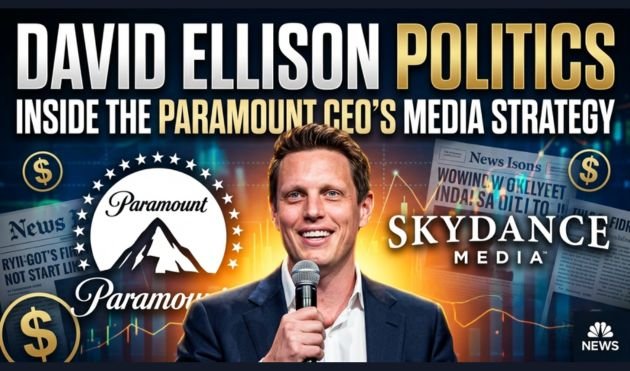
The intersection of media consolidation, corporate finance, and federal regulation often reshapes the landscape of public discourse. In recent years, few figures have illustrated this dynamic as vividly as David Ellison, the founder of Skydance Media and the current Chairman and Chief Executive Officer of Paramount Skydance. Historically recognized for high-budget cinematic productions such as Top Gun: Maverick and the Mission: Impossible franchise, Ellison has increasingly become a focal point of discussion regarding contemporary media politics, regulatory alignment, and ideological shifts within legacy broadcasting.
As the tech-wealth-derived capital of the Silicon Valley elite merges with the traditional narrative engines of Hollywood and New York, the personal ideology, strategic alliances, and political evolution of executives like Ellison carry profound implications. Evaluating David Ellison through the lens of political alignment, financial influence, and institutional restructuring reveals how corporate media navigation intersects with shifting federal power dynamics. For a detailed breakdown of corporate governance standards during massive media transitions, the Harvard Law School Forum on Corporate Governance provides authoritative legal analysis on how executive transitions alter corporate liability.
The Ideological Evolution: Is David Ellison a Democrat or a Republican?
To understand David Ellison’s current political positioning, one must examine a trajectory that spans traditional West Coast corporate liberalism, pragmatic bipartisan engagement, and a recent pivot toward alignment with conservative political structures.
For much of his adult life, Ellison operated within the standard ideological framework of Hollywood executives, frequently describing himself as a “socially liberal person.” This public self-characterization aligned with the dominant cultural sensibilities of the entertainment industry. His historical financial contributions reflected this baseline, culminating in substantial financial backing for center-left national campaigns. Federal election records indicate that during the 2024 election cycle, Ellison contributed $929,600 to back President Joe Biden’s reelection efforts, highlighting a concrete connection to the establishment wing of the Democratic Party.
However, the period following the 2025 corporate merger of Skydance Media and Paramount Global marked a distinct shift in how political observers, industry insiders, and media analysts categorized his alignment. Since late 2025, Ellison has been increasingly characterized as an ally of the Republican administration led by President Donald Trump.
This transition suggests that labeling Ellison strictly as a conventional ideologue—either a lifelong conservative or an unyielding progressive—fails to capture the strategic nature of contemporary media ownership. Instead, his political profile reflects a synthesis of personal pragmatism and structural alignment with prevailing federal regulatory bodies. While his historical donor profile aligns with democratic institutions, his executive decisions and recent public associations indicate a profound comfort operating within, and catering to, conservative political ecosystems. For deep historical tracking of media bias claims and ownership changes across decades, the Pew Research Center Journalism Project offers comprehensive empirical data.
The Trump Alignment and the Regulatory Ecosystem
The relationship between David Ellison and the second Trump administration underscores the critical role that executive branch favor plays in massive corporate mergers. The transaction that formed Paramount Skydance Corporation required strict scrutiny from independent federal agencies, most notably the Federal Communications Commission (FCC).
During the regulatory evaluation of the Skydance-Paramount transaction, standard historical precedents regarding executive non-involvement in corporate mergers were notably altered. President Donald Trump personally engaged in the evaluation process. To facilitate a smooth regulatory path through an FCC headed by Trump-appointed Chairman Brendan Carr, strategic concessions and legal resolutions were pursued. Notably, Paramount executed a $16 million settlement in July 2025 to resolve a long-standing dispute involving a CBS-Trump lawsuit, effectively clearing immediate regulatory friction.
Following the completion of the merger, the relationship between Ellison and administration officials moved into a highly public phase:
-
State of the Union Appearance: Ellison attended the 2026 State of the Union address as the official guest of influential Republican Senator Lindsey Graham, signaling clear entry into high-level conservative circles.
-
Washington Gala: In April 2026, Ellison hosted a high-profile event in Washington, D.C., titled “Honoring the Trump White House,” which brought together senior administration officials alongside top executives and journalists from CBS News.
This public rapprochement has drawn sharp scrutiny from political adversaries. In May 2026, Democratic leadership within the House Committee on the Judiciary and the Committee on Energy and Commerce launched formal inquiries. Led by Ranking Members Jamie Raskin and Frank Pallone, the committees demanded documentation detailing whether Paramount Skydance was actively coordinating with administration officials to alter independent news coverage in exchange for favorable regulatory treatment. Legal analysts tracking these administrative investigations often refer to filings found on the U.S. House Committee on the Judiciary public repository to cross-reference corporate disclosures with congressional mandates.
Institutional Overhaul: The Restructuring of CBS News
The most tangible evidence of David Ellison’s shifting political strategy is found in the editorial and structural transformations enacted at CBS News immediately following the acquisition. Legacy news networks have long faced allegations of systemic bias from conservative critics, and Ellison moved decisively to address these concerns through leadership changes designed to appeal to a broader ideological spectrum.
The defining appointment of this new era occurred in October 2025, when Ellison selected heterodox political commentator and journalist Bari Weiss as the editor-in-chief of CBS News. Concurrently, Paramount acquired Weiss’s digital media outlet, The Free Press, integrating its editorial philosophy into the legacy broadcast infrastructure. The stated objective behind this restructuring was to reorient the network away from perceived coastal partisan bubbles and toward what Ellison characterized as the unaddressed center of American life.
“What our goal is in news is we want to become the most trusted destination in news media,” Ellison stated during an industry forum. “We basically believe in all the things that the Free Press believed in: which is we want to speak to the 70% of the audience that identifies themselves as center-left to center-right.”
This institutional pivot was accompanied by significant internal friction and the departure of established journalistic figures:
-
Editorial Mandates: Under the guidance of newly appointed FCC Chair Brendan Carr, Ellison implemented strategic operational adjustments, including the elimination of specific diversity, equity, and inclusion (DEI) mandates, and the installation of Kenneth R. Weinstein—formerly of the right-leaning Hudson Institute—as an independent CBS ombudsman tasked with auditing reportorial bias.
-
High-Profile Departures: The transition generated open resistance within the ranks. In early 2026, veteran anchor Scott Pelley was dismissed from 60 Minutes following internal conflicts regarding the new editorial direction. Similar leadership shakeups saw other prominent figures, including long-standing correspondents, exit the network amid concerns over mounting executive pressure.
To understand the broader implications of corporate media directives on working journalists, the Columbia Journalism Review provides regular peer-reviewed assessments of editorial independence under new corporate management.
Expanding the Portfolio: The Warner Bros. Discovery Acquisition
The strategic alignment cultivated during the Paramount merger laid the groundwork for an even larger consolidation effort in early 2026: Paramount Skydance’s hostile takeover bid for Warner Bros. Discovery (WBD). Valued at over $110 billion, the transaction represents one of the largest entertainment media consolidations in corporate history, designed to merge the assets of HBO, Warner Bros. Studios, and CNN with the existing Paramount-CBS apparatus.
The political dimension of the WBD acquisition centers heavily on the future orientation of CNN, an organization that had been a frequent target of presidential criticism. Wall Street documentation and congressional inquiries revealed that Ellison and his father, Oracle co-founder Larry Ellison, provided explicit assurances to administration officials that a successful acquisition would result in sweeping operational and editorial changes at CNN, mirroring the restructuring previously executed at CBS News.
To capitalize the immense scale of the $110 billion transaction, Ellison assembled a highly sophisticated, geopolitically complex coalition of investors. The capital structure relied heavily on partnerships with three sovereign wealth funds owned by Middle Eastern governments, alongside significant financial participation from Affinity Partners, the private equity firm founded by the president’s son-in-law, Jared Kushner. This fusion of international sovereign wealth, politically connected domestic funds, and legacy media infrastructure has positioned Ellison as a primary architect of the modern, consolidated media state. Comprehensive timelines and corporate filings detailing these large-scale transactions can be monitored via the U.S. Securities and Exchange Commission EDGAR System, which logs all mandatory investor disclosures.
Political Donations and Financial Framework
Understanding David Ellison’s political footprint requires distinguishing his individual financial activities from the broader, monumental donor legacy of his family. The financial power underpinning Skydance and its subsequent expansions is deeply tethered to the capital generated by Oracle Corporation.
| Asset / Metric | Entity / Individual | Strategic Relevance |
| Larry Ellison Net Worth | $170B+ (Oracle Corporation) | Foundational capital source; primary guarantor for major media acquisition bids. |
| David Ellison Net Worth | Estimated $2B – $4B (Independent) | Personal net worth heavily augmented by familial trust structures and Skydance equity. |
| Primary 2024 Contribution | David Ellison ($929,600) | Directed to Biden Victory Fund prior to the corporate merger pivot. |
| Primary 2026 Contribution | David Ellison ($1,000,000) | Directed to Security is Strength Super PAC (supporting Senator Lindsey Graham). |
| Historical Family Giving | Larry Ellison ($30M+ in 2022) | Massive historical support for conservative causes, including Senator Tim Scott’s committees. |
While David Ellison’s individual giving history shows a pragmatic division between center-left and center-right entities depending on the legislative calendar, his recent seven-figure allocation to Senator Graham’s Super PAC confirms a deliberate realignment with the legislative leadership overseeing media antitrust and regulatory compliance. To audit real-time campaign finance reports and verification matrices for all corporate executives, the Federal Election Commission Campaign Finance Database serves as the primary federal open-data authority.
The Question of Cultural and Religious Identity
Beyond the immediate mechanics of corporate filings and political donations, public interest frequently extends to the personal, cultural, and familial background of media proprietors. David Ellison was born in Santa Clara County, California, to Larry Ellison and his third wife, Barbara Boothe Ellison. He was raised primarily in Woodside, California, an affluent enclave within Silicon Valley.
In terms of cultural and religious heritage, the Ellison family background is multifaceted. Larry Ellison was born to an unwed mother of Jewish descent and was subsequently raised by adoptive relatives in a reform Jewish home in Chicago, later discovering his biological maternal lineage was of Italian descent. David Ellison’s upbringing was largely secular, centered on aviation, competitive piloting, and cinematic arts rather than formal theological structures. His public profile remains entirely focused on corporate governance, media technology, and cinematic production, with no active affiliation or public commentary regarding personal religious practices.
Ellison’s immediate family structure is similarly integrated into the upper echelons of California’s creative and professional communities. In 2011, he married Sandra Lynn Modic, a former actress and singer. The couple resides primarily in Southern California, maintaining a low personal profile relative to the immense public and political visibility of the corporate media assets under Ellison’s direct control. For readers interested in sociological trends surrounding philanthropy and regional demographics within California’s tech communities, the Silicon Valley Community Foundation tracks civic and cultural developments extensively.
The 70% Centrist Thesis vs. Market Reality
The overarching philosophical justification presented by David Ellison for his media strategy rests on what industry analysts term the “Centrist Thesis.” In multiple corporate addresses following the formation of Paramount Skydance, Ellison argued that modern media ecosystems have alienated the vast majority of citizens by catering exclusively to hyper-partisan extremes. His stated commercial strategy is to capture what he identifies as an underserved market segment: the roughly 70% of Americans who view themselves as politically moderate, center-left, or center-right.
However, comprehensive empirical data compiled by major non-partisan polling organizations presents a more complex view of the American electorate, challenging the structural viability of Ellison’s thesis.
Data published by major institutional platforms indicates that while a significant portion of the population self-identifies as “independent” during initial questioning, the vast majority of those individuals exhibit consistent, deeply entrenched voting patterns that lean decisively toward one of the two major political parties. When accounting for these leaners, less than 15% of the electorate functions as a true, unaligned ideological center. For a breakdown of voter trends, state election results, and registration demographics, the Harvard Dataverse Network provides open-source access to academic political datasets.
Furthermore, media consumption metrics demonstrate that audiences for dedicated television news channels are disproportionately composed of highly partisan individuals. Because politically active consumers are the demographics most likely to sustain daily news consumption habits, industry analysts suggest that an attempt to build a mass-market news network strictly around a sanitized, non-partisan center faces inherent structural headwind.
The strategy implemented by Ellison—introducing more conservative-friendly commentary, appointing figures like Bari Weiss, and curtailing traditional corporate diversity initiatives—may therefore be less about reaching a purely neutral, centrist population, and more about repositioning legacy assets to compete directly for center-right audiences while simultaneously securing a harmonious relationship with federal regulatory authorities.