Who Is Jay Clayton? An Introduction to One of America’s Most Consequential Legal Figures
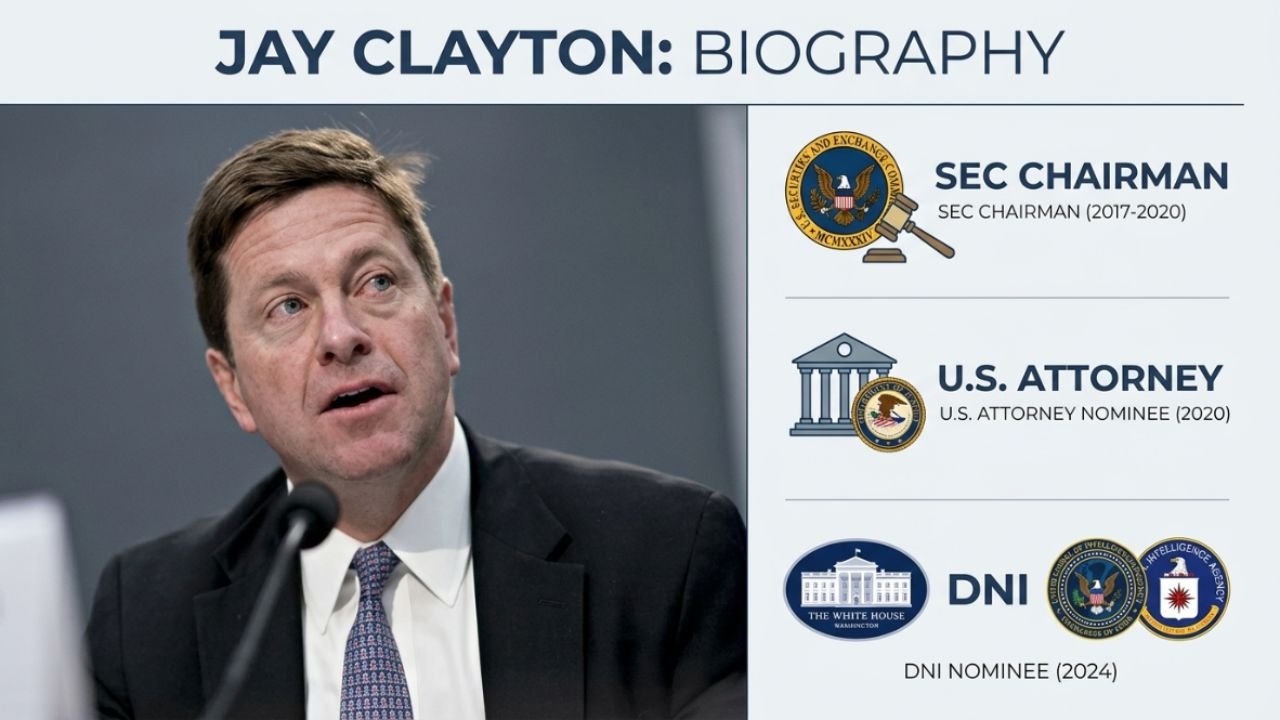
Walter Joseph “Jay” Clayton III is one of those rare individuals whose career trajectory keeps bending toward history. Born on July 11, 1966, in Newport News, Virginia, Clayton has spent three decades moving between the highest corridors of Wall Street and Washington — advising billion-dollar corporations, chairing the U.S. Securities and Exchange Commission (SEC), prosecuting Venezuela’s sitting president, overseeing the Jeffrey Epstein investigation, and, as of June 2026, being nominated by President Donald Trump to serve as the next Director of National Intelligence (DNI).
Whether you are searching for Jay Clayton’s biography, trying to understand his intelligence experience, or wondering about his political affiliation and personal life, this article answers every question with verified, current information.
Jay Clayton Early Life and Education: Built for High-Stakes Work
Clayton was born at Fort Eustis, a military installation in Newport News, Virginia, and raised primarily in central and southeastern Pennsylvania — specifically in Wallingford, where he met his future wife at Strath Haven High School.
His academic record is exceptional by any standard. He earned a Bachelor of Science in Engineering from the University of Pennsylvania (summa cum laude), then crossed the Atlantic as a Thouron Scholar to study at King’s College, Cambridge, where he earned both a B.A. and M.A. in Economics. He then returned to Penn for his Juris Doctor from the University of Pennsylvania Law School (cum laude, Order of the Coif).
This combination — engineering precision, economics training, and elite legal education — gave Clayton an analytical toolkit that few Washington insiders can match. He didn’t study political science or international affairs. He studied how systems work, how markets behave, and how the law governs both.
Pro Tip for Readers: Clayton’s engineering background explains a lot about how he approaches regulatory problems: not ideologically, but structurally. It’s a pattern you’ll see throughout his career.
After law school, he clerked for Judge Marvin Katz of the U.S. District Court for the Eastern District of Pennsylvania from 1993 to 1995 — a formative experience in understanding federal judicial thinking before joining the private sector.
Jay Clayton Career: From Sullivan & Cromwell to the Halls of Power
The Sullivan & Cromwell Years (1995–2017)
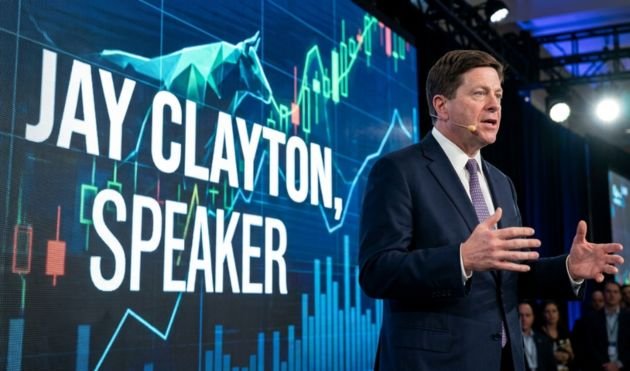
In 1995, Clayton joined Sullivan & Cromwell LLP, one of the most prestigious law firms in the world. He rose from associate to partner in 2001 and spent over two decades there — eventually serving on the firm’s Management Committee and co-heading its Corporate Practice Group.
His client list reads like a who’s who of global finance. He advised:
- Goldman Sachs during its $5 billion investment from Warren Buffett’s Berkshire Hathaway
- The Alibaba Group on its record-breaking $25 billion IPO in 2013 — at the time the largest in history
- Paul Tudor Jones, billionaire hedge fund founder
- Reid Hoffman, LinkedIn co-founder and prominent venture capitalist
- Ocwen Financial’s former head William Erbey
Clayton was also deeply involved in cross-border transactions, regulatory exposure counseling, and crisis management for multinational banks. This is the foundation of his expertise: not courtroom litigation, but the architecture of complex financial relationships and the regulatory frameworks that govern them.
From 2009 to 2017, he simultaneously served as a Lecturer in Law and Adjunct Professor at the University of Pennsylvania Law School, where he taught securities regulation and corporate governance.
Source: Sullivan & Cromwell LLP Profile
Jay Clayton as SEC Chairman: What He Actually Accomplished (2017–2020)
On January 20, 2017 — the same day Donald Trump was inaugurated — Trump nominated Jay Clayton to chair the Securities and Exchange Commission. The Senate confirmed him and he was sworn in on May 4, 2017.
His three-and-a-half-year tenure as SEC Chairman was defined by several major priorities:
1. Protecting Retail Investors
Clayton made retail investor protection the organizing theme of his chairmanship. He pushed for clearer disclosure rules, fought against financial products that obscured risk, and worked to democratize access to investment opportunities that had historically been restricted to institutional players.
2. Digital Asset and Cryptocurrency Regulation
Clayton brought the SEC’s attention squarely onto cryptocurrencies during a period when the market was exploding with unregistered ICOs (Initial Coin Offerings). His now-famous statement — “I believe every ICO I’ve seen is a security” — set the tone for years of crypto regulation debates. He initiated enforcement actions against dozens of unregistered token offerings.
However, his handling of digital assets has since come under scrutiny. Critics have alleged that his regulatory decisions appeared to favor Ethereum and Bitcoin while simultaneously pursuing enforcement against Ripple (XRP) — a case that began under his tenure and became one of the most consequential cryptocurrency lawsuits in U.S. history.
3. Capital Markets Modernization
Clayton pushed to modernize IPO rules, simplify registration requirements for smaller companies, and reduce regulatory barriers to public capital markets. He believed the declining number of publicly listed U.S. companies was a structural problem worth addressing.
4. Congressional Testimony
Clayton testified frequently before Congress on cybersecurity, U.S.-China economic interdependence, market integrity, and COVID-19-related regulatory responses after he resigned in December 2020.
He stepped down as SEC Chairman on December 23, 2020, at the end of Trump’s first term.
Sources:
Jay Clayton After the SEC: Apollo, Academia, and the Return to Public Service
After leaving the SEC, Clayton did not retreat from public life. He took on several high-profile roles:
- Chairman of Apollo Global Management (2021–2025): Apollo is one of the world’s largest alternative investment firms. Clayton chaired its board of directors — a role that would later create significant conflict-of-interest questions when he was appointed to lead the Epstein investigation.
- Of Counsel and Senior Policy Advisor at Sullivan & Cromwell: He returned to his old firm in an advisory capacity.
- Board Member, American Express Company: Overseeing governance at one of America’s most iconic financial brands.
- Adjunct Professor, Wharton Business School (from 2021): Extending his academic career into business education.
- Co-Chair, University of Pennsylvania Institute for Law and Economics (2022–2025)
- Member, FDIC Systemic Resolution Advisory Committee (from January 2022)
This period demonstrates a pattern consistent with Clayton’s entire career: maintaining simultaneous influence in the private sector, academia, and regulatory policy — a revolving door that supporters call broad expertise and critics call a conflict of interest.
Jay Clayton as U.S. Attorney for the Southern District of New York (2025–Present)
In April 2025, Jay Clayton became the U.S. Attorney for the Southern District of New York (SDNY) — arguably the most powerful prosecutor’s office in the United States, known for its independence and its history of landmark cases.
Trump had first attempted to place Clayton in this role in June 2020, when he fired then-U.S. Attorney Geoffrey Berman. Clayton declined at the time. In 2025, with Trump back in the White House, Clayton accepted the interim appointment, and in August 2025, a panel of federal judges voted to formally appoint him to the role after the Senate did not advance his confirmation.
His priorities at SDNY have included:
- Gun violence and gang prosecution
- Drug trafficking, including cartel-linked operations
- Cybercrime and securities fraud
- Sex trafficking and child exploitation
- National security threats
Two cases have defined his tenure:
The Nicolás Maduro Indictment
Clayton’s office secured one of the most extraordinary prosecutions in SDNY history: the indictment of Venezuelan President Nicolás Maduro on narco-terrorism and drug trafficking charges. This was a case with enormous geopolitical implications, pursued aggressively despite diplomatic complexity.
The Sean “Diddy” Combs Prosecution
After a jury verdict in the Combs sex trafficking trial, Clayton issued a statement describing the seriousness of the crimes with deliberate, measured language — a signal that his office would continue pursuing high-profile accountability cases.
Source: SDNY – Meet the U.S. Attorney
Jay Clayton and the Epstein Investigation: Conflict of Interest Questions
In November 2025, Attorney General Pam Bondi assigned Jay Clayton to lead the federal investigation into Jeffrey Epstein’s ties to prominent political figures — including former President Bill Clinton and others named in Epstein documents released by Congress.
The assignment generated immediate controversy — not because of Clayton’s competence, but because of his professional history.
The conflict-of-interest concerns:
- Apollo Global Management: Clayton held between $1.5 million and $6 million in Apollo stock at the time of his appointment. Leon Black, Apollo’s co-founder, had paid Epstein over $150 million for financial advice between 2012 and 2017. Black was later accused of additional serious misconduct and stepped down as CEO in 2021.
- Reid Hoffman: Clayton had previously provided legal representation to Hoffman, a tech billionaire identified as a frequent visitor to Epstein’s island.
- Wall Street Banking Ties: SDNY was simultaneously investigating major banks for suspicious financial transactions tied to Epstein-linked accounts — some of which were former clients of Sullivan & Cromwell during Clayton’s partnership years.
Critics, including government watchdog groups, argued these overlapping ties created “a paralyzing bias” and called for Clayton to recuse himself or resign from the investigation.
Clayton has not publicly responded to these specific conflict-of-interest allegations. His office has continued to pursue the investigation.
Sources:
- The New Republic – Trump’s Epstein Investigator Has Financial Ties
- NPR – Bondi Assigns Clayton to Epstein Investigation
- CNN – Epstein Investigation Is Latest Test for Jay Clayton
Jay Clayton DNI Nomination: Intelligence Experience Under the Microscope
On June 11, 2026, President Trump announced on Truth Social that he would nominate Jay Clayton as the next Director of National Intelligence, succeeding Tulsi Gabbard whose resignation was taking effect.
The announcement came after bipartisan backlash over Trump’s earlier appointment of Bill Pulte — a federal housing official with no intelligence background — as acting DNI. That appointment had directly led the House of Representatives to vote against extending Section 702 of the Foreign Intelligence Surveillance Act (FISA), a critical national security tool.
Clayton’s nomination was received with cautious optimism across party lines:
- Rep. Jim Himes (D-CT), top Democrat on the House Intelligence Committee, called Clayton someone he had “known and respected for decades,” calling him a “terrific” choice.
- Sen. Richard Blumenthal (D-CT) called Clayton “a vast improvement” over Pulte but raised concerns about whether he meets the statutory intelligence experience requirement.
- Sen. Mark Warner (D-VA), vice chairman of the Senate Intelligence Committee, said he had “great respect for Jay Clayton” but questioned the timing.
The central legal question: Federal law requires the DNI to have “substantial national security expertise.” Clayton’s background is in corporate law, financial regulation, and prosecution — not intelligence operations, counterterrorism, or foreign policy. Whether his legal career, which touched on international transactions, cybersecurity, and national security-adjacent prosecutions (Maduro, Epstein), qualifies under that standard remains an open question for his Senate confirmation hearing, scheduled for June 17, 2026.
Sources:
- Washington Post – Trump Picks Jay Clayton as DNI
- CBS News – Jay Clayton Nominated as DNI
- The Hill – Trump ODNI Nomination Jay Clayton
- CNBC – Trump Names Jay Clayton as National Intelligence Director
Jay Clayton: Republican or Democrat? Political Affiliation Explained
Jay Clayton is registered as a political independent. He is not a Republican and is not a Democrat.
This is not unusual for high-level legal and regulatory figures who need to project impartiality in their roles. However, in practice, Clayton’s government career has been entirely shaped by Republican administrations under Donald Trump — nominated as SEC chair in 2017, appointed as SDNY U.S. attorney in 2025, and now nominated as DNI in 2026.
Democrats have largely treated him as a capable professional operating within a partisan framework — critical of specific decisions and conflict-of-interest concerns, but not hostile to him personally in the way they have been toward other Trump appointees.
Clayton himself rarely discusses partisan politics in public statements, preferring to frame his work in terms of institutional integrity and rule of law.
Source: Wikipedia – Jay Clayton (attorney)
Jay Clayton Wife: Gretchen Butler Clayton
Jay Clayton met his wife, Gretchen Butler Clayton, at Strath Haven High School in Wallingford, Pennsylvania — a remarkably grounded origin story for a relationship between two people who would later move in the highest circles of American finance.
Gretchen Butler Clayton is the daughter of Daniel Butler, who served as CEO of CSC (Computer Sciences Corporation) from 1975 to 1998. She built her own distinguished career as a Vice President and Wealth Manager at Goldman Sachs, where she advised some of America’s wealthiest families and individuals for approximately 17 years. She stepped down from Goldman Sachs around the time Jay was nominated to chair the SEC.
The couple have three children together. They have summered in Ocean City, New Jersey, throughout their lives — a detail Clayton mentioned during a 2019 visit to Ocean City High School, where he spoke to students about investing and financial literacy.
The family’s combined net worth is estimated at more than $50 million, according to public financial disclosures.
Sources:
- Philadelphia Inquirer – Jay Clayton Visits Ocean City High School
- Wall Street on Parade – Wall Street’s Top Cop
Jay Clayton Net Worth: What the Financial Disclosures Reveal
Jay Clayton’s publicly disclosed net worth reflects decades of elite private practice and board-level corporate positions.
Key figures from financial disclosures:
- Family wealth: At least $50 million, the majority held in diversified investments including Vanguard mutual funds
- 2016 income: Clayton earned approximately $7.6 million from Sullivan & Cromwell in his final year at the firm before joining the SEC
- Apollo Global Management holdings: Between $1.5 million and $6 million in Apollo stock as of his 2025 disclosures
- Other holdings: Bank stocks and investments in financial firms — some of which are under active investigation by his own office
These holdings have created ongoing ethical scrutiny and recusal questions, particularly regarding the Epstein investigation and Wall Street fraud cases being handled by SDNY.
Sources:
Jay Clayton Religion: What Is Known
Jay Clayton’s religious beliefs have not been a prominent part of his public profile. There is no verified public record of him identifying with a specific religion or making religious affiliation part of his public identity.
His wife, Gretchen Butler Clayton, has been identified in biographical sources as Christian. The family’s background — raised in Pennsylvania, educated at elite institutions, involved in civic and philanthropic activities — is consistent with mainstream American Christian tradition, but Clayton himself has not made religion a defining element of his public or professional identity.
This is consistent with a professional posture that prioritizes institutional credibility over personal disclosure, similar to the approach he takes to political affiliation.
Jay Clayton and Trump: A Relationship Built on Mutual Trust
The relationship between Jay Clayton and Donald Trump is one of the most consequential personal-professional alignments in contemporary American legal history.
It began with Clayton’s SEC nomination on Trump’s first Inauguration Day in January 2017. Over the years, the relationship deepened:
- They are known to have golfed together
- Trump praised Clayton as among the most respected figures “in the Legal Community”
- Trump attempted to install Clayton at SDNY during his first term in 2020
- Trump appointed Clayton to SDNY again immediately after returning to office in 2025
- Trump nominated Clayton as DNI in June 2026
Clayton has reciprocated with public support for Trump’s positions, appearing on CNBC to defend administration policies on First Amendment grounds and, controversially, suggesting that the public was “right to question” California election vote tallies — a position critics viewed as echoing Trump’s election conspiracy theories.
The relationship is not unconditional loyalty — Clayton has maintained a reputation for prosecutorial independence at SDNY — but it is clearly a relationship of deep mutual trust that has positioned Clayton for the most significant role of his career.
Sources:
- MSNBC/MaddowBlog – Trump Nominates Jay Clayton as DNI
- Newsweek – Who Is Jay Clayton, New DNI Nominee
Key Facts About Jay Clayton at a Glance
| Attribute | Detail |
|---|---|
| Full Name | Walter Joseph “Jay” Clayton III |
| Date of Birth | July 11, 1966 |
| Birthplace | Newport News, Virginia |
| Education | UPenn (BS Engineering, JD), Cambridge (MA Economics) |
| Political Affiliation | Independent |
| Religion | Not publicly disclosed |
| Wife | Gretchen Butler Clayton (former Goldman Sachs VP) |
| Children | Three |
| Net Worth | $50 million+ (family) |
| SEC Chairman | May 2017 – December 2020 |
| SDNY U.S. Attorney | April 2025 – Present |
| DNI Nomination | June 11, 2026 |
What Jay Clayton’s Nomination as DNI Means for America’s Intelligence Community
The Director of National Intelligence oversees the entire U.S. intelligence community — 18 agencies in total, including the CIA, NSA, DIA, and others. The DNI serves in the President’s Cabinet, coordinates intelligence gathering, and is the principal intelligence advisor to the President, the National Security Council, and the Homeland Security Council.
If confirmed, Clayton would come to this role as:
✅ A proven federal regulator with experience overseeing a large federal agency (SEC) ✅ A sitting federal prosecutor running one of the nation’s most complex U.S. attorney’s offices ✅ A former corporate lawyer with deep experience in international financial transactions, cybersecurity, and cross-border regulatory exposure ✅ A trusted confidant of the sitting President
But also: ⚠️ A figure with no prior intelligence, military, or foreign policy background ⚠️ A nominee under active scrutiny for conflict-of-interest questions tied to his financial holdings ⚠️ A lawyer who has never managed a workforce involved in classified intelligence operations
His confirmation hearing on June 17, 2026 will be one of the most closely watched in years — with both parties asking hard questions about whether a financial regulator turned prosecutor is equipped to lead America’s spy agencies at a moment of significant geopolitical complexity.
Frequently Asked Questions About Jay Clayton
Is Jay Clayton a Republican or a Democrat?
Neither. Jay Clayton is a registered independent. His government roles have all been under Republican President Donald Trump, but he does not publicly identify with either party.
Who is Jay Clayton’s wife?
His wife is Gretchen Butler Clayton, a former Goldman Sachs VP and wealth manager. They met in high school in Pennsylvania and have three children together.
What is Jay Clayton’s net worth?
His family’s net worth is estimated at over $50 million, based on public financial disclosures. In 2016, his final year at Sullivan & Cromwell, he earned approximately $7.6 million.
Did Jay Clayton have anything to do with Jeffrey Epstein?
Clayton did not have a personal relationship with Epstein. However, he was assigned by AG Pam Bondi to lead the federal investigation into Epstein’s connections to prominent political figures in November 2025. Critics raised conflict-of-interest concerns because Clayton had financial and professional ties to individuals connected to Epstein, including through his Apollo board chairmanship and legal representation of Reid Hoffman.
What experience does Jay Clayton have in intelligence?
Clayton has no direct intelligence background. His national security-adjacent experience includes overseeing major prosecutions (Maduro indictment), financial crime investigations with international dimensions, cybersecurity policy work at the SEC, and cross-border regulatory exposure from his Sullivan & Cromwell years. Critics argue this is insufficient for the statutory requirements of the DNI role.
What is Jay Clayton’s religion?
Jay Clayton has not publicly disclosed his religious affiliation.
Jay Clayton’s Unfinished Story
Jay Clayton’s career is a study in institutional trust and the weight of expertise in an era of political turbulence. He built credibility over 30 years advising the most powerful financial institutions in the world, then spent four years running the agency responsible for policing them, then stepped into the most powerful prosecutor’s office in America, and now stands on the threshold of leading the nation’s intelligence community.
Whether his confirmation as DNI succeeds — and whether the conflict-of-interest questions surrounding the Epstein investigation ultimately affect his reputation — Jay Clayton’s story is not yet finished. What is certain is that few figures in contemporary American public life have moved through as many high-stakes institutions as effectively, or positioned themselves as durably for continued relevance.
His Senate confirmation hearing on June 17, 2026 will be the next chapter.