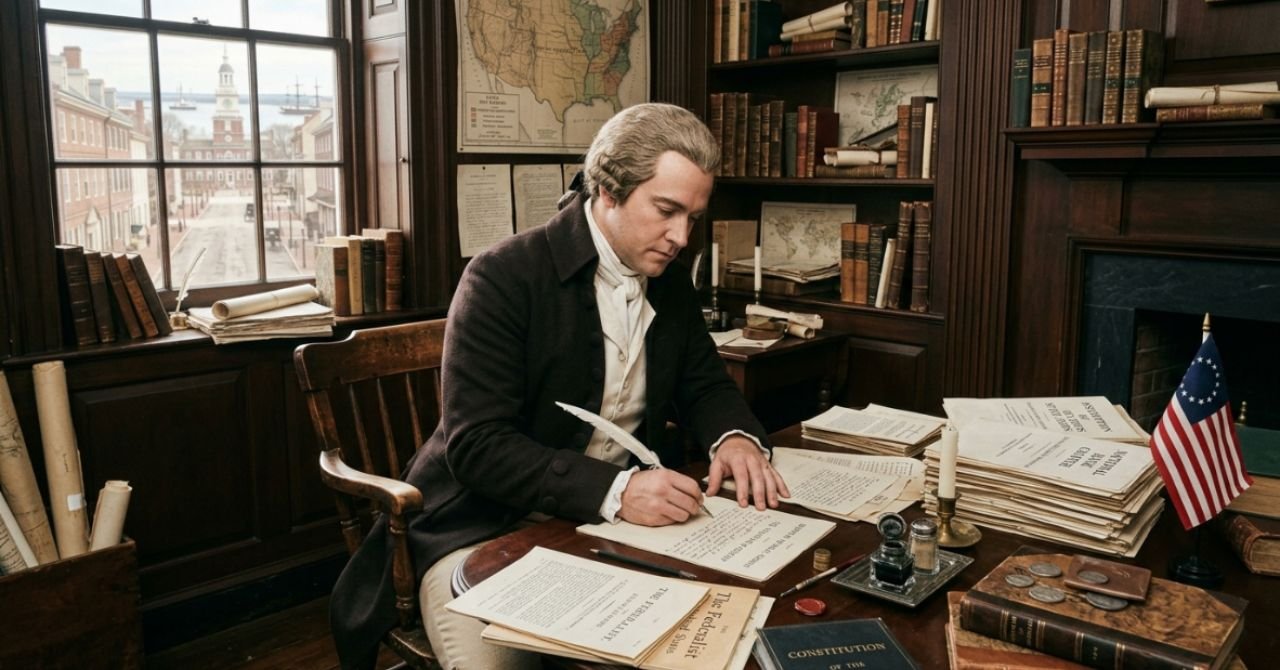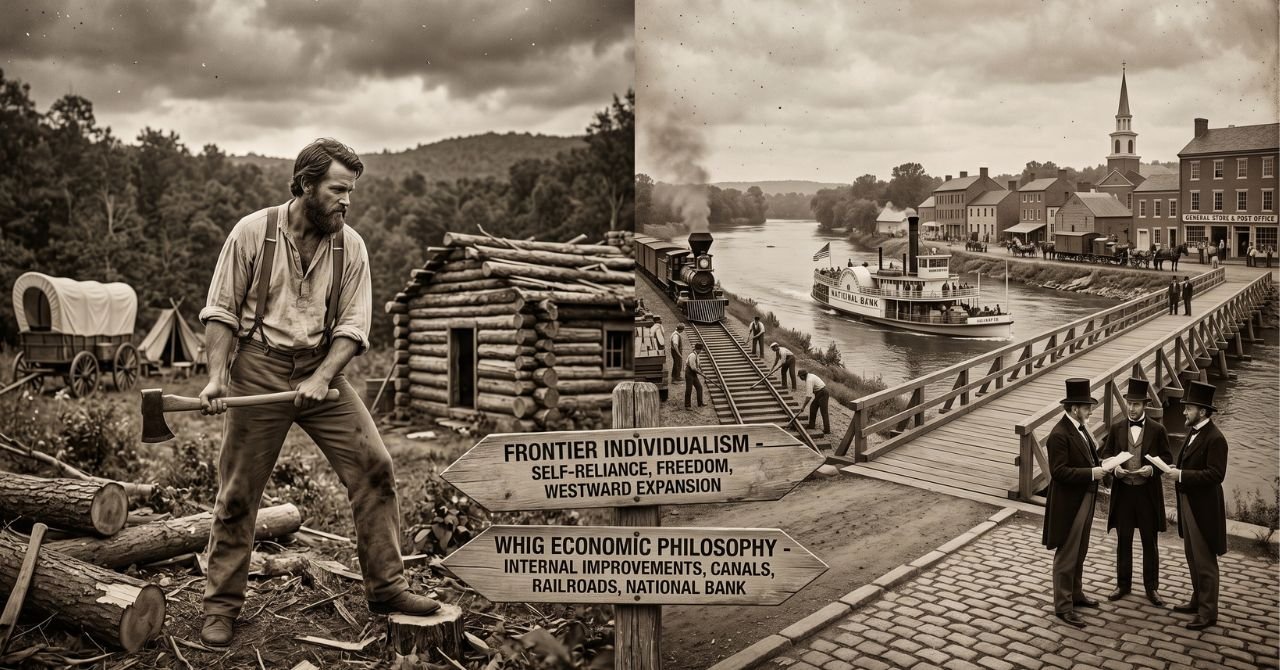
Lincoln’s political ideology was not formed in a vacuum. It was forged on the American frontier and polished through the lens of Whig economic theory. Born into poverty in a log cabin in Kentucky and raised in Indiana, Lincoln’s early life epitomized the frontier struggle. However, unlike many of his contemporaries who embraced Jacksonian Democracy—which championed the agrarian ideal and a limited federal footprint—Lincoln aligned himself with Henry Clay’s Whig party.
[Henry Clay's American System]
       │
       ├───► National Banking (Stabilize Currency)
       ├───► Protective Tariffs (Shield Domestic Industry)
       └───► Internal Improvements (Roads, Canals, Railroads)
This alignment was critical. Clay’s “American System” advocated for a strong central government that actively fostered economic development through:
-
A national banking system
-
Protective tariffs to shield domestic industry
-
Federally funded “internal improvements” (roads, canals, and railroads)
Lincoln viewed economic mobility as the core of human liberty. He did not idealize the agrarian lifestyle; instead, he championed the “free labor” system, which posited that every man should have the right to enjoy the fruits of his own industry and elevate his social condition. Detailed analysis of this economic philosophy can be found through the National Park Service’s Lincoln Home Historic Site, which preserves the environment where his legal and political ideologies matured.
His transition to law in Springfield, Illinois, provided the analytical rigor that would define his statesmanship. As a highly successful railroad attorney, Lincoln mastered the complexities of property rights, corporate law, and constitutional boundaries. This professional background instilled in him a profound reverence for the rule of law and statutory interpretation, traits that governed his cautious, deliberate approach to the slavery crisis during his political ascent.
The Constitutional Crisis of the 1850s: The House Divided
The decade preceding the Civil War witnessed the systematic collapse of the political compromises that had held the United States together since the Constitutional Convention of 1787. Lincoln emerged from a period of political retirement following the passage of the Kansas-Nebraska Act of 1854, engineered by his long-time rival, Stephen A. Douglas.
The Kansas-Nebraska Act and Popular Sovereignty
The Kansas-Nebraska Act repealed the Missouri Compromise of 1820 by introducing the concept of “popular sovereignty,” which allowed territories to vote on whether to permit slavery. Lincoln recognized that this was not merely a political shift, but a profound moral and legal regression.
In his famous Peoria Speech of 1854, Lincoln articulated his core argument against the extension of slavery: it violated the foundational premise of the nation—that all men are created equal. He argued that the Founding Fathers had tolerated slavery as a temporary necessity, placing it on a path toward “ultimate extinction.” Douglas’s doctrine, by contrast, neutralized the moral weight of the institution, treating it as a mere local preference akin to choosing a crop.
The Lincoln-Douglas Debates of 1858
When Lincoln challenged Douglas for the Illinois Senate seat in 1858, the resulting seven debates became the defining intellectual battleground of the century. The complete transcriptions and historical contexts of these arguments are curated by the Abraham Lincoln Presidential Library and Museum, offering an unfiltered look at 19th-century political rhetoric.
| Debate Topic / Context | Lincoln’s Position | Douglas’s Position |
| The Moral Status of Slavery | Slavery is a moral wrong; the Declaration of Independence applies to all humans. | Indifferent to the morality of slavery; focused purely on white self-governance. |
| The Freeport Doctrine | Forced Douglas to choose between popular sovereignty and the Dred Scott decision. | Claimed citizens could exclude slavery by refusing to pass local police regulations. |
| The Future of the Union | A house divided against itself cannot stand; the nation must become all free or all slave. | Believed the nation could exist indefinitely half slave and half free through local autonomy. |
During the Freeport debate, Lincoln strategically backed Douglas into a corner. He asked whether the people of a territory could lawfully exclude slavery prior to forming a state constitution, especially in light of the Supreme Court’s Dred Scott v. Sandford ruling, which stated that Congress had no power to exclude slavery from territories. Douglas’s response—the “Freeport Doctrine”—alienated Southern Democrats, splitting the party and paving the way for Lincoln’s presidential victory in the 1860 election.
The Geometry of Legal Thought: Lincoln’s Rhetorical Strategy
Lincoln’s writing and speaking styles are celebrated for their clarity, brevity, and profound emotional resonance. What is less frequently analyzed is the geometric precision of his arguments. As a young adult, Lincoln mastered the first six books of Euclid’s Elements. He did not merely read them; he committed the logical structures to memory.
“He studied and nearly mastered the six books of Euclid since he was a member of Congress. He began a course of rigid mental discipline with the view to improve his faculties, and especially his powers of logic and synthesis.” — John G. Nicolay and John Hay, Abraham Lincoln: A History
This commitment to Euclidean geometry directly shaped his political prose. A typical Lincoln speech behaves like a geometric proof: it begins with universally accepted axioms, introduces clear definitions, proceeds through a sequence of undeniable historical or legal facts, and arrives at an inescapable conclusion.
In the Cooper Union Address of February 1860—the speech that effectively secured him the Republican presidential nomination—Lincoln conducted an exhaustive historical analysis of the 39 signers of the U.S. Constitution. He demonstrated that a clear majority of them had voted on measures to regulate or restrict slavery in federal territories. By treating the historical record as data points for a logical proof, he dismantled the Southern claim that federal restriction of slavery was unconstitutional or revolutionary. He framed conservatism not as the defense of slavery, but as the defense of the Founders’ original intent to restrict it.
Executive Authority and the Fluid Boundaries of War
Upon taking the oath of office in March 1861, Lincoln confronted an unprecedented constitutional emergency. Seven states had already seceded, forming the Confederate States of America, and federal properties were under siege. His response to the attack on Fort Sumter altered the nature of the presidency, testing the limits of Article II of the Constitution.
During the initial months of the war, while Congress was in recess, Lincoln assumed extraordinary emergency powers, executing a series of unilateral actions:
-
He called up 75,000 militia forces.
-
He ordered a naval blockade of Southern ports.
-
He unauthorized the expenditure of public funds for military purchases without congressional appropriation.
-
He suspended the writ of habeas corpus along key transit routes between Washington D.C. and Philadelphia.
The Suspension of Habeas Corpus and Ex parte Merryman
Lincoln’s suspension of habeas corpus—the legal procedure protecting citizens against arbitrary detention—provoked an immediate constitutional showdown. Chief Justice Roger B. Taney, sitting as a circuit judge, issued a ruling in Ex parte Merryman declaring Lincoln’s action unconstitutional, arguing that the power to suspend the writ rested exclusively with Congress under Article I, Section 9.
Lincoln deliberately chose to ignore Taney’s order. In his July 4, 1861, Address to Congress, he delivered his famous defense of his actions, posing a question that remains central to constitutional crisis management:
“Are all the laws, but one, to go unexecuted, and the government itself go to pieces, lest that one be violated?”
Lincoln argued that the executive oath required him to preserve the government at all costs. He maintained that the Constitution could not logically contain a clause that required the destruction of the entire constitutional order for the sake of observing a single procedural limitation. Furthermore, he noted that the Constitution does not explicitly state which branch has the authority to suspend the writ during an insurrection, only that it may be done when public safety requires it. The evolution of these presidential powers and federal law during this era is thoroughly documented by the Cornell Law School Legal Information Institute, serving as a benchmark for modern constitutional interpretation.
The Path to Emancipation: Military Necessity Meets Constitutional Law
The transformation of the Civil War from a conflict to preserve the Union into a revolutionary war to abolish slavery required careful legal navigation. Lincoln was intensely aware that as president, he had no constitutional authority to interfere with local institutions within loyal states. Even within seceded states, any premature move toward emancipation risked alienating the critical Border States of Kentucky, Missouri, Maryland, and Delaware, potentially losing the war entirely.
[Evolution of Federal Anti-Slavery Policy]
       │
       ├──► First Confiscation Act (1861): Seizure of slaves used for Confederate military purposes
       │
       ├──► Second Confiscation Act (1862): Freedom for slaves of disloyal owners in Union-controlled areas
       │
       └──► Emancipation Proclamation (1863): Full liberation of slaves in all rebelling territories
The Legal Framework of the Emancipation Proclamation
Lincoln utilized his constitutional status as Commander-in-Chief of the Army and Navy under Article II, Section 2, to issue the Emancipation Proclamation. Because it was framed strictly as a “fit and necessary war measure,” the proclamation’s legal authority was confined exclusively to areas currently in rebellion against the United States.
By anchoring the proclamation in military necessity, Lincoln protected it from judicial intervention. He argued that enslaved labor was a vital economic and logistical asset to the Confederate war effort; seizing that asset and converting it to the Union cause was as constitutionally valid as capturing enemy vessels or munitions.
However, Lincoln recognized the inherent frailty of this mechanism. As a war measure, the legal validity of the Emancipation Proclamation might expire once peace was restored. Furthermore, it did not apply to the Border States or to portions of the South under Union control. This understanding drove his aggressive political maneuvering in late 1864 and early 1865 to secure the passage of the Thirteenth Amendment through the House of Representatives, permanently anchoring the abolition of slavery within the text of the Constitution itself.
Re-Writing the American Narrative: The Gettysburg Address
If the Declaration of Independence stated the premise of the American experiment and the Constitution provided the operational code, the Gettysburg Address fused them into a single, cohesive national identity. Delivered on November 19, 1863, at the dedication of the Soldiers’ National Cemetery, Lincoln’s 272-word speech shifted the center of gravity of American constitutional law.
[The Structural Continuum of the American Republic]

   Declaration of Independence (1776) ──► The Core Philosophical Premise ("All men are created equal")
                                                   │
                                                   ▼
   U.S. Constitution (1787)           ──► The Operational Mechanism (Federal structure, compromises)
                                                   │
                                                   ▼
   Gettysburg Address (1863)          ──► The Intellectual Synthesis (Nation dedicated to a proposition)
Prior to Gettysburg, the United States was frequently referred to in the plural: “the United States are.” Lincoln’s rhetoric systematically shifted the usage to the singular: “the United States is.”
He chose not to cite the Constitution, which contained compromises regarding slavery; instead, he dated the birth of the nation to 1776—”four score and seven years ago”—when a new nation was “conceived in Liberty, and dedicated to the proposition that all men are created equal.”
By defining the Civil War as a test of whether a nation so conceived could endure, Lincoln reframed the conflict. The preservation of the Union was no longer merely about territorial integrity or enforcement of federal statutes; it was an existential struggle for the survival of global democracy, ensuring that “government of the people, by the people, for the people, shall not perish from the earth.”
Grand Strategy and Military Management
Lincoln’s presidency provides an exceptional case study in strategic leadership under extreme duress. Lacking formal military training apart from a brief stint in the Black Hawk War, Lincoln mastered military science through intensive study at the Library of Congress. He understood what many of his professional generals did not: the American Civil War required a strategy of total, coordinated destruction of the Confederacy’s capacity to wage war.
The Search for a Strategic General
For the first three years of the war, Lincoln clashed repeatedly with his military commanders, most notably Major General George B. McClellan. McClellan was an expert organizer and tactician but suffered from a cautious reluctance to risk his army in decisive engagements. Lincoln famously frustrated McClellan by urging him to use his numerical advantage, writing:
“If you don’t want to use the army, I should like to borrow it for a while.”
Lincoln’s strategic insight was formalized when he promoted Ulysses S. Grant to Lieutenant General and General-in-Chief of all Union armies in March 1864. Lincoln and Grant shared an identical strategic vision: the primary objective was not the capture of geographic markers like Richmond, but the simultaneous containment and destruction of the Confederate armies. Grant, alongside William Tecumseh Sherman and Philip Sheridan, executed a multi-theater offensive that leveraged the North’s superior industrial base, manpower, and railway logistics, grinding down the Confederacy along an extended front.
[Union Joint Strategic Implementation (1864-1865)]
         │
         ├──► Grant (Army of the Potomac): Pins down Lee's Army of Northern Virginia
         │
         └──► Sherman (Western Theater): Executes deep logistical strikes (March to the Sea)
The Second Inaugural Address: Political Theology and Reconstruction
As the war neared its end in March 1865, Lincoln turned his intellectual focus to the problem of national reconciliation. His Second Inaugural Address stands as one of the most profound documents in American political theology. Rather than celebrating the imminent triumph of the North, Lincoln delivered a contemplative, self-reflective analysis of the war’s deeper meaning.
Lincoln refused to claim moral superiority for the Union, noting that both sides “read the same Bible, and pray to the same God; and each invokes His aid against the other.” He framed the Civil War as a divine judgment upon the entire nation for the sin of American slavery—an institution shared by both North and South:
“Fondly do we hope—fervently do we pray—that this mighty scourge of war may speedily pass away. Yet, if God wills that it continue, until all the wealth piled by the bond-man’s two hundred and fifty years of unrequited toil shall be sunk, and until every drop of blood drawn with the lash, shall be paid by another drawn with the sword, as was said three thousand years ago, so still it must be said ‘the judgments of the Lord, are true and righteous altogether.'”
This theological humility served a vital political purpose. By distributing the guilt of slavery across the entire nation, Lincoln laid the psychological groundwork for his magnanimous vision of Reconstruction. The address concluded with a roadmap for peace, rejecting punitive retribution in favor of national healing:
                  [Lincoln's Post-War Architecture]
                                 │
         ┌───────────────────────┴───────────────────────┐
         ▼                                               ▼
"With malice toward none"                      "With charity for all"
The Legacy of Institutional Transformation
Abraham Lincoln’s assassination on April 14, 1865, by John Wilkes Booth, occurred just days after the surrender of Robert E. Lee’s army at Appomattox Court House. His death martyred him in the eyes of the public, but his enduring legacy rests on the profound structural transformation he executed during his four years in office.
Beyond the preservation of the state and the destruction of chattel slavery, Lincoln’s administration oversaw a massive expansion of federal capability that accelerated the industrialization of the United States:
-
The Homestead Act of 1862: Granted 160 acres of public land to Western settlers, democratizing land ownership and accelerating continental development.
-
The Morrill Land-Grant College Act: Allocated federal lands to states to fund institutions of higher education focused on agriculture and the mechanic arts, laying the foundation for America’s public university system.
-
The Pacific Railway Act: Authorized the federal construction of the First Transcontinental Railroad, physically tying the Pacific coast to the industrial core of the nation.
-
The National Banking Acts: Established a unified national currency and a stable federal banking system, permanently shifting financial power away from individual states to Wall Street and Washington D.C.
Lincoln inherited a decentralized, fragile republic divided by section and paralyzed by constitutional contradictions. Through a masterclass in political pragmatism, constitutional flexibility, and rhetorical genius, he forged a unified modern state capable of asserting its authority at home and eventually projecting its values globally. He proved that an open, democratic society possesses the internal resilience to defend itself against internal destruction without sacrificing its foundational commitment to human liberty.
Comprehensive Reference Resources
For deep analysis and historical verification of Abraham Lincoln’s life, political career, and legal legacy, consult the following authoritative repositories and academic collections:
-
The Collected Works of Abraham Lincoln: Maintained by the Abraham Lincoln Association, this archive contains the definitive, searchable collection of Lincoln’s correspondence, speeches, and public papers.
-
The Library of Congress Digital Collections: The Abraham Lincoln Papers at the Library of Congress offers high-resolution digitizations of original historical manuscripts, incoming letters, and drafts of major presidential addresses.
-
The National Archives and Records Administration (NARA): Access the foundational legal documents of the Civil War era, including the original text of the Emancipation Proclamation and the Thirteenth Amendment.
-
The Papers of Abraham Lincoln Project: Hosted by the Illinois State Historical Library, this comprehensive documentary editing project offers detailed indexing of Lincoln’s legal career and regional political developments.