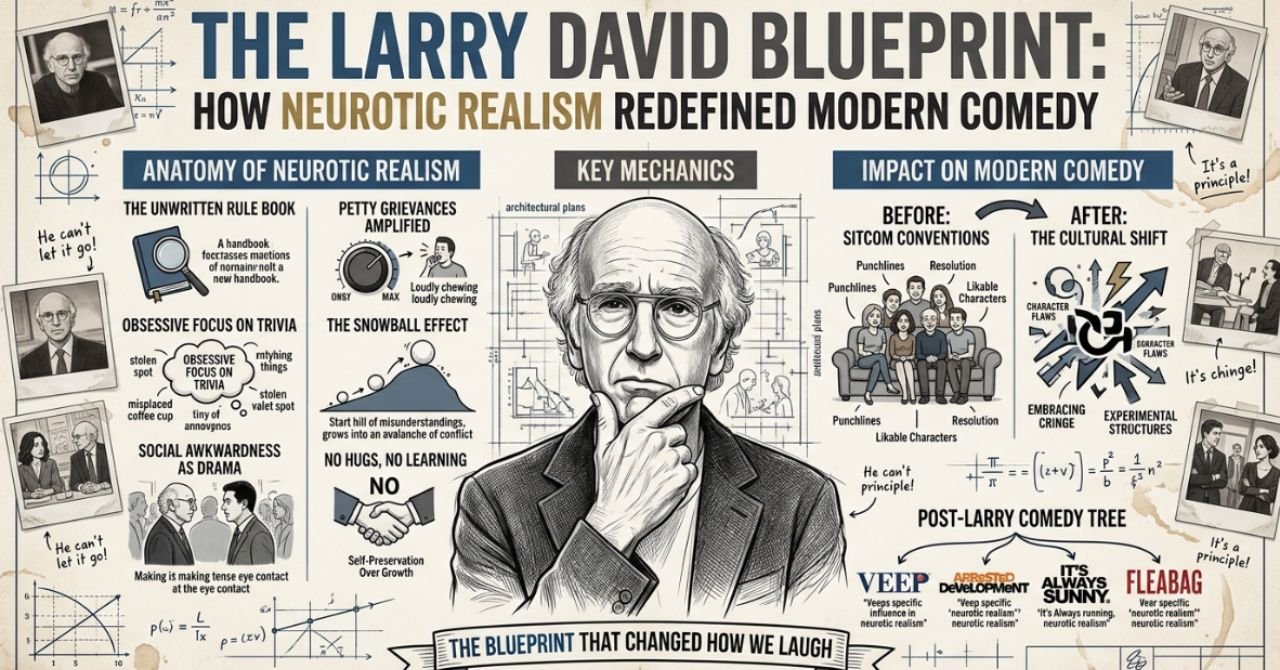
As the co-creator of Seinfeld and the singular force behind Curb Your Enthusiasm, David established a comedic paradigm that prioritizes structural complexity, semantic precision, and psychological realism over traditional joke-telling. His work operates as an anthropological study of contemporary human behavior, exposing the delicate, often absurd unwritten rules that govern daily interactions. This exhaustive analysis explores the evolutionary trajectory of Larry David’s career, the structural mechanics of his writing, and his enduring influence on twenty-first-century media and storytelling.
The Early Years: The Crucible of Failure and the Stand-Up Scene
To understand the uncompromising nature of Larry David’s creative output, one must first examine his formative years in New York City. Born in Brooklyn in 1947, David’s early life was steeped in the distinct cultural rhythms of post-war Jewish-American life, an environment that heavily informed his comedic cadence and preoccupation with familial anxiety and existential dread.
After a brief stint in the United States Army Reserve and a variety of odd jobs—ranging from a taxi driver to a bra salesman—David committed to the grueling circuit of New York stand-up comedy during the 1970s and 1980s. Unlike many of his contemporaries who sought immediate validation from the audience, David’s relationship with the crowd was notoriously combative. If an audience failed to respond to his material, he was known to scold them, refuse to perform, or simply walk off the stage entirely.
This period of sustained professional frustration was critical. It was during these years of marginal commercial success that David refined his unique comedic lens: the idea that the minutiae of everyday life—the etiquette of a buffet line, the politics of a handshake, the awkwardness of ending a conversation—contained infinite narrative potential. His brief, tumultuous tenure as a writer for Late Night sketch shows, including ABC’s Fridays and a single, highly frustrated season at NBC’s Saturday Night Live (SNL), further solidified his distaste for traditional, compromise-driven commercial entertainment. At SNL, only one of his sketches ever made it to air, leading to a legendary incident where he quit in a fury on a Friday, only to show up on Monday acting as if nothing had happened—a real-life event that would later become a classic storyline on Seinfeld.
The Seinfeld Revolution: Constructing the ‘Show About Nothing
In 1989, Larry David partnered with fellow comedian Jerry Seinfeld to develop a pilot for NBC initially titled The Seinfeld Chronicles. What emerged from this partnership was a radical departure from the prevailing sitcom conventions of the era. While network executives clamored for warm, family-friendly narratives with clear moral centers, David implemented a strict, non-negotiable creative directive for the writers’ room: “No hugging, no learning.”
The Architecture of the Four-Plot Structure
The brilliance of Seinfeld during Larry David’s tenure as head writer and showrunner lay in its revolutionary structural engineering. Prior to Seinfeld, most sitcoms followed a linear A-plot supplemented by a minor B-plot. David perfected a complex, multi-narrative tapestry where four disparate characters pursued completely independent, often trivial goals, only for their storylines to converge in the final minutes of the episode in a crescendo of cosmic irony. Detailed season breakdowns and episode guides on IMDb’s Seinfeld Directory showcase how frequently this exact formula was executed across the show’s nine-year run.
Consider landmark episodes such as “The Contest,” “The Marine Biologist,” or “The Chinese Restaurant.” These episodes rejected grand theatrical stakes in favor of hyper-focused micro-narratives. “The Chinese Restaurant,” for example, takes place entirely in real-time as the characters wait for a table. It was an episode that NBC executives actively fought against, fearing it would alienate audiences. Instead, it became a cultural touchstone, proving that narrative tension could be derived entirely from the mundane frustrations of urban existence.
George Costanza: The Ultimate Alter Ego
Through the character of George Costanza, brilliantly embodied by actor Jason Alexander, Larry David placed his own anxieties, neuroses, and ethical shortcomings under a national microscope. George was petty, deceitful, vindictive, and deeply insecure—yet, remarkably, audiences found him deeply relatable. By externalizing his internal monologues through George, David tapped into a universal truth: most people are far less noble than they pretend to be in polite society. The catharsis of the show came from watching characters act on their worst impulses without the artificial resolution of a moral lesson at the end of thirty minutes. Academic analyses featured in Encyclopedia Britannica’s Seinfeld Essay emphasize George’s character as a groundbreaking archetype of the anti-hero in television history.
Curb Your Enthusiasm: The Hyper-Realism of Autonomy
Following his departure from Seinfeld after its seventh season, and the subsequent conclusion of the series in 1998, Larry David faced the ultimate creative challenge: how to follow an unmitigated cultural phenomenon. His response came in 1999 with an HBO comedy special that blossomed into the long-running series HBO’s Curb Your Enthusiasm Portal.
If Seinfeld was an optimized, highly polished manifestation of David’s worldview, Curb Your Enthusiasm was the raw, unedited thesis statement. Playing a fictionalized, ultra-wealthy version of himself living in Los Angeles, David stripped away the traditional artifice of television production.
The Improvised Outline and Verbatim Realism
The defining technical innovation of Curb Your Enthusiasm is its abandonment of traditional scriptwriting. For each episode, David authors a meticulous 5-to-10-page scene-by-scene outline detailing the narrative beats, structural turning points, and final comedic payoffs. The actual dialogue, however, is entirely improvised by the actors on set.
This technique yields a level of naturalistic speech—complete with stutters, interruptions, and genuine behavioral awkwardness—that written dialogue rarely captures. It allowed the series to explore the delicate nuances of human communication, where a slight inflection or an awkward pause becomes the catalyst for catastrophic social warfare. The show’s brilliant recurring cast, including Cheryl Hines, Jeff Garlin, Susie Essman, and the late Richard Lewis, provided the perfect collaborative foils for David’s escalating confrontations. Critical reviews and production insights hosted on Rotten Tomatoes’ Curb Your Enthusiasm Hub highlight how this unique structural format maintained its high critical acclaim for over twelve seasons.
The table below highlights the distinct evolution in creative execution between David’s two masterworks:
| Creative Element | Seinfeld Era (1989–1998) | Curb Your Enthusiasm Era (2000–2024) |
|---|---|---|
| Format & Scripting | Strictly scripted, multi-camera, filmed before a live studio audience. | Improvised dialogue based on detailed story outlines, single-camera. |
| Protagonist Dynamics | Surrogate self represented through George Costanza and Jerry Seinfeld. | Larry David playing an unvarnished, billionaire version of himself. |
| Narrative Scope | The claustrophobic, middle-class anxieties of New York City life. | The elite, high-society politics of West Los Angeles and celebrity culture. |
| Creative Freedom | Governed by network television standards and practices (NBC). | Uncensored exploration of adult themes and language on premium cable (HBO). |
The Social Assassin: The Philosophical Core of David’s Work
At the heart of Larry David’s entire body of work lies a profound, almost philosophical preoccupation with the concept of social obligation. In an episode of Curb Your Enthusiasm, the character of Jeff Greene refers to Larry as a “social assassin”—a moniker that perfectly encapsulates his narrative function. Larry David, the character, says the things that real-world individuals think but suppress in order to preserve social harmony.
David’s comedy serves as an deconstruction of societal norms, exposing them as arbitrary constructs. Whether he is questioning the valid timeframe for a “Happy New Year” greeting in mid-January, challenging the ethics of a “sample abuser” at an ice cream parlor, or dissecting the invisible boundary of a “chat and cut” in a long line, he acts as an unyielding referee for human behavior.
“A date is an experience you have with another person that makes you appreciate being alone.” — Larry David
This perspective is deeply intertwined with a specific brand of secular Jewish-American existentialism, a subject widely examined by cultural historians and media scholars. Readers can explore deep dives into how this specific cultural background shapes modern performance art in the Rolling Stone Culture Archives, where David’s long-form interviews are meticulously documented. His work finds deep kinship with the literary anxieties found in the works of twentieth-century writers, where the self is perpetually caught in a vice grip between internal desires and external societal expectations.
Technical Mastery: Cross-Cutting and Comic Pacing
Beyond the thematic brilliance, Larry David’s contribution to television comedy is profoundly technical. His editing choices and structural pacing transformed how comedy is consumed. The rapid cross-cutting between narrative tracks in Curb Your Enthusiasm prevents the momentum from stalling, ensuring that every scene serves either as a setup for a future conflict or the explosive payoff of a previous one.
Furthermore, David’s precise understanding of comedic timing relies heavily on the use of silence and facial choreography. The famous “stare-down” sequences in Curb—wherein Larry looks deeply into another character’s eyes to discern if they are lying, accompanied by a tense, inquisitive musical motif—demonstrates how tension can be leveraged to generate immense comedic relief without a single line of spoken dialogue. Industry-standard industry breakdowns on television editing styles can be verified through The Hollywood Reporter Features, illustrating how David’s technical approach influenced a generation of independent filmmakers.
The Cultural Legacy: Influence on Modern Media and Beyond
The ripple effects of Larry David’s comedic philosophy are visible across the contemporary media landscape. The rise of the “cringe comedy” genre—exemplified by landmark television series such as Ricky Gervais and Stephen Merchant’s masterpiece available on the BBC Programming Guide, Arrested Development, Peep Show, and Veep—owes an immense debt to the trail blazed by David. These programs reject the traditional, comforting artifice of early network television, choosing instead to find humor in discomfort, human fallibility, and structural irony.
Moreover, his influence extends into the digital age, where social media commentary frequently utilizes “Larry David moments” as a universal shorthand for navigating the awkward, unwritten protocols of modern life. Historical archives and retrospective reporting on his late-career honors can be tracked via The New York Times Arts Section. His work has achieved a rare level of permanence: it has become an interpretive framework through which millions of people view their own daily social frictions.
The Enduring Value of Absolute Candor
Larry David’s career stands as a masterclass in creative integrity and uncompromising vision. In an industry often characterized by imitation and risk aversion, he consistently chose to follow his own idiosyncratic instincts. He recognized that the truest comedy is not found in grand romantic gestures or neatly resolved plotlines, but in the awkward gaps, silent frustrations, and petty grievances that define the reality of everyday human existence.
By transforming his deep internal anxieties into a universal language of neurotic realism, Larry David did more than just entertain audiences for nearly four decades. He changed how we talk, how we observe human behavior, and how we laugh at the deeply flawed, endlessly complex experience of living in society.