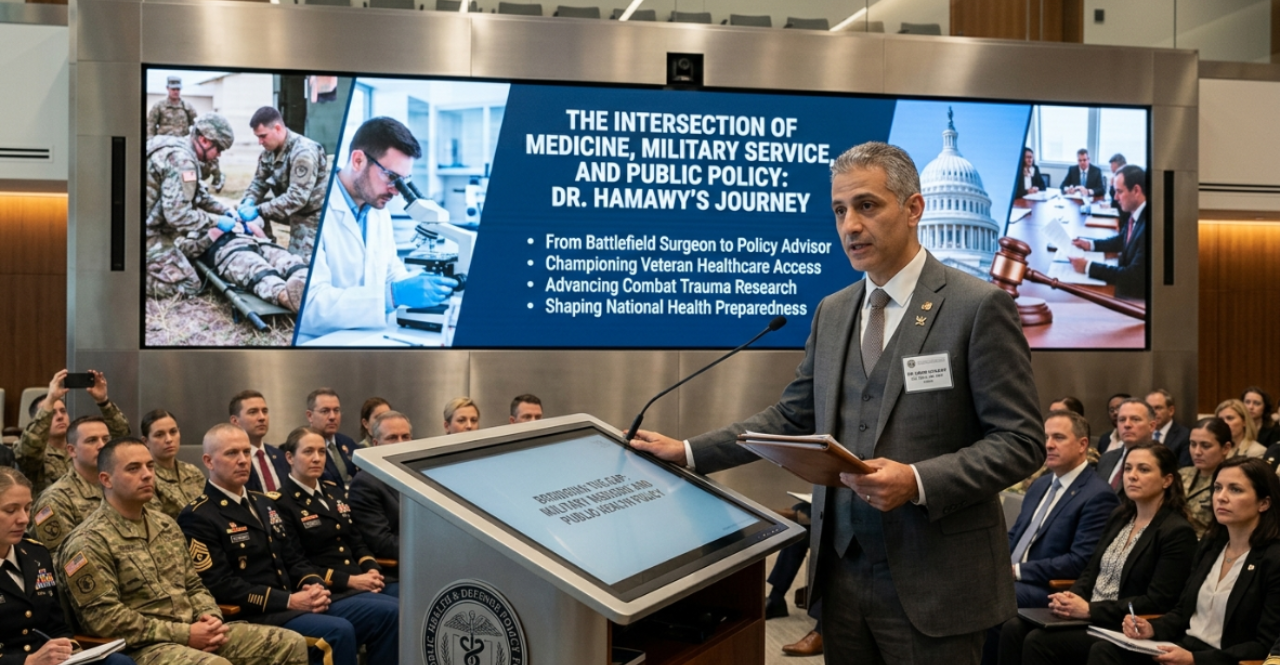
In the landscape of modern American governance, the transition from professional medicine to public policy carries a unique weight. Among the contemporary figures embodying this dual path, Dr. Adam Hishan Hamawy stands out as a compelling study of how frontline humanitarian crisis and military trauma care can reshape a professional’s trajectory toward national policy advocacy.
As an accomplished plastic and reconstructive surgeon, a decorated U.S. Army Medical Corps combat veteran, and an active voice in humanitarian medical relief, Dr. Hamawy’s public and civic engagement offers an insightful window into how real-world crisis management informs domestic and foreign policy perspectives.
Academic Foundations and Professional Medical Expertise
To evaluate the expertise driving Dr. Hamawy’s civic perspectives, one must look at his foundational training in complex surgical disciplines. His career has been defined by rigorous structural execution, specializing in highly technical reconstructive procedures that require both microscopic precision and long-term patient rehabilitation management.
Education and Clinical Training
Dr. Hamawy’s academic trajectory reflects a deep alignment with elite medical and corporate structures within the northeastern United States:
-
Undergraduate Education: He completed his foundational undergraduate studies at Rutgers University, establishing his early roots in the New Jersey academic ecosystem.
-
Medical Doctor (MD) Degree: He earned his medical degree with distinct honors from the New Jersey Medical School, which is historically tied to the University of Medicine and Dentistry of New Jersey (UMDNJ) and now integrated under Rutgers University.
-
Surgical Residency & Fellowships: To master general surgery and complex tissue reconstruction, he completed an intensive residency at Weill Cornell Medicine, followed by a highly competitive fellowship in plastic and reconstructive surgery at the University of Texas Southwestern Medical Center.
-
Macro-Healthcare Education: Recognizing that modern medicine is deeply intertwined with institutional finance and corporate structures, he went on to earn a Master of Business Administration (MBA) from Rutgers University–Camden, providing him with a structural understanding of healthcare systems and administration.
For nearly two decades, Dr. Hamawy maintained a highly regarded private practice based in Princeton, New Jersey. While his clinical focus centered on advanced aesthetic and intricate reconstructive surgeries, it was his parallel commitment to public service and military trauma care that ultimately redefined his career path.
Military Service and the Lifelong Bond with Senator Tammy Duckworth
Long before his name surfaced in broader public policy discussions, Dr. Hamawy translated his civic duty into active military service,
enlisting in the New Jersey National Guard and later serving as a Lieutenant Colonel in the United States Army Medical Corps. His deployment during the Iraq War placed him at the frontlines of battlefield medicine, operating under high-intensity conditions at the 31st Combat Support Hospital in Baghdad.
The Emergency in Baghdad (2004)
It was during this intense deployment in 2004 that Dr. Hamawy’s medical expertise directly intercepted a pivotal moment in American political history. A Black Hawk helicopter co-piloted by then-Army Captain Tammy Duckworth was shot down by a rocket-propelled grenade (RPG) over Iraq. Captain Duckworth suffered catastrophic, life-threatening trauma, resulting in the loss of both of her legs and severe damage to her right arm.
Dr. Hamawy was the lead trauma surgeon on duty when the crew was evacuated to the combat support hospital. Utilizing his specialized training in vascular and reconstructive surgery, he led the grueling, emergency operations that successfully stabilized her vitals and saved her life.
This critical event forged a profound, lifelong bond between the surgeon and the soldier. Decades later, when Tammy Duckworth transitioned into public service—eventually becoming a prominent U.S. Senator representing Illinois—she publicly and repeatedly credited Dr. Hamawy’s immediate surgical interventions as the primary reason for her survival. This enduring relationship would later serve as an important bridge connecting Dr. Hamawy’s grassroots humanitarian advocacy directly with federal legislative avenues in Washington, D.C.
The Gaza Humanitarian Missions: A Catalyst for Policy Advocacy
While his experiences in the Iraq War established his credentials as a military trauma expert, it was his voluntary humanitarian work during international conflicts that propelled Dr. Hamawy into active public and foreign policy discussions. His first-hand accounts of civilian medical crises have become central points of reference for policy analysts evaluating international aid frameworks.
The 2024 Medical Deployment
In mid-2024, amid the severe escalation of the conflict in the Gaza Strip, Dr. Hamawy joined a volunteer delegation of international medical specialists. Organized by independent humanitarian networks, the mission aimed to provide emergency orthopedic, vascular, and reconstructive surgical care to wounded Palestinian civilians caught in the crossfire.
Operating out of local medical facilities under severe structural constraints, Dr. Hamawy treated a continuous influx of blast injuries, severe shrapnel wounds, and complex amputations—frequently performing procedures on pediatric patients without access to optimal surgical infrastructure, clean water, or standard post-operative medication.
The Rafah Evacuation Standoff
The mission took a dangerous turn when military operations expanded into southern Gaza, leading to the closure of the critical Rafah border crossing. This event effectively trapped Dr. Hamawy and a specialized team of international physicians inside the active combat zone, with rapidly depleting food, medical supplies, and fuel reserves. The situation sparked a complex multi-national diplomatic standoff.
In Washington, Senator Tammy Duckworth, learning that the surgeon who saved her life in Baghdad was now trapped under fire, actively intervened. Leveraging her position, she coordinated directly with the White House, the U.S. State Department, and international relief organizations to establish a secure evacuation corridor for the stranded American medical personnel.
Demonstrating a strict adherence to his medical and military ethics, Dr. Hamawy refused early evacuation offers, insisting on remaining on-site until all non-American medical staff and vulnerable patients under his immediate care were accounted for and granted safe passage out of the immediate danger zone.
Public Witness and First-Hand Accounts
Upon returning to the United States, Dr. Hamawy transitioned from a quiet private practitioner into an active public witness. His descriptions of the systemic collapse of healthcare infrastructure and the psychological trauma inflicted upon civilian populations were widely cited by major media outlets, human rights monitoring groups, and policy institutes. He frequently emphasized that medical professional organizations must speak out against the structural factors that generate humanitarian crises, noting that treating individual wounds is insufficient when the systemic causes remain unchecked.
Core Ideological Perspectives and Public Policy Stances
Dr. Hamawy’s evolving public platform is distinct because it combines rigid military pragmatism with human-centric healthcare advocacy. His public commentary and policy positions focus heavily on reformative measures across foreign aid, domestic health delivery, and corporate regulatory standards.
1. Re-Evaluating Foreign Policy and International Military Aid
Drawing directly from his deployments in both Iraq and Gaza, Dr. Hamawy advocates for a fundamental re-evaluation of how the United States allocates military assistance and manages international diplomacy. He has emerged as a distinct voice arguing that international military aid must be bound to strict human rights compliance and international law framework verification.
His commentary often addresses the psychological and diplomatic stagnation caused by unconditional defensive and offensive aid configurations. He has publicly noted that insulation from the immediate geopolitical consequences of conflict can sometimes inadvertently delay long-term, equitable peace negotiations. His approach emphasizes robust diplomatic engineering, humanitarian aid access as a non-negotiable global standard, and the proactive reduction of civilian casualities in global conflict zones.
2. Healthcare Reform: Systemic Accessibility as National Security
As an executive MBA graduate and clinical director who has managed both private medical businesses and military field trauma units, Dr. Hamawy brings a analytical perspective to the ongoing American healthcare debate. He strongly critiques the employer-tied, private insurance-dominated medical model, framing it as economically inefficient and a threat to domestic stability.
He supports a transition toward a universal, single-payer healthcare system, often aligning with the Medicare for All framework. Unlike career political figures, his arguments are structured around system sustainability and operational efficiency:
-
Comprehensive Coverage Unity: Universal access must naturally encompass mental health resources, preventative diagnostic screening, dental care, and long-term physical rehabilitation.
-
Pharmaceutical Price Stabilization: Utilizing federal volume purchasing power to directly negotiate and cap the soaring costs of essential prescription medications and life-saving drugs.
-
Infrastructure Re-investment: Directing federal capital injections into public community health networks, rural trauma hubs, and underfunded urban municipal hospitals to eliminate geographic healthcare deserts.
3. Corporate Responsibility and Digital Consumer Protections
Dr. Hamawy’s medical ethics extend heavily into contemporary digital regulations and public wellbeing. He has been a vocal advocate within professional medical circles regarding the psychological impacts of predatory corporate digital marketing targeted at vulnerable demographics, particularly minors.
He has spoken out against the proliferation of predatory cosmetic alteration apps, digital filters, and algorithmic social targeting designed to exploit juvenile insecurities. His policy perspectives champion strict regulatory oversight on AI-driven targeted advertising, enhanced digital privacy protections for families, and corporate accountability for technology conglomerates whose platforms demonstrate a measurable degradation of youth mental health and self-esteem.
Public Alignments and Civic Institutional Trust
As Dr. Hamawy’s public profile has expanded, his perspectives have garnered substantial interest from major grassroots networks, anti-war coalitions, and progressive advocacy organizations seeking individuals with practical, non-traditional backgrounds to inject into public discourse.
His public efforts and analytical viewpoints share alignment with several key public frameworks and civil society initiatives:
-
Humanitarian & Legal Accountability: His testimonials frequently support the data sets and field reports generated by organizations such as Human Rights Watch, documenting the ground realities of conflict zones.
-
Progressive Advocacy Integration: His stances on healthcare and foreign policy have drawn collaborative praise from institutional reform networks, including groups like Justice Democrats and Our Revolution, which prioritize elevating veterans and working professionals into national policy dialogues.
-
Veterans For Peace Initiatives: His unique perspective as a military officer who actively critiques unyielding foreign military engagement has made him a valued speaker for veterans’ groups focused on re-centering diplomacy in American international relations.
The Broader Impact of Experiential Representation
The trajectory of Dr. Adam Hamawy underscores a broader shift in how communities evaluate leadership and authority in public governance. In an era often dominated by career political strategists, his path highlights the growing appeal of experiential representation—the idea that those who have directly managed the consequences of policy decisions on the frontlines bring an invaluable, pragmatic perspective to the legislative drafting table.
Whether performing complex vascular repairs under mortar fire in Baghdad, navigating international borders to deliver volunteer surgical care in Gaza, or addressing academic and public policy forums in New Jersey, Dr. Hamawy’s journey illustrates the profound impact of combining elite technical expertise with an unyielding commitment to global humanitarian principles. His evolving role continues to challenge conventional boundaries, demonstrating that the frontlines of global crises are increasingly becoming the training grounds for the next generation of public policy advocates.