What Does “Tracqueur” Actually Mean?
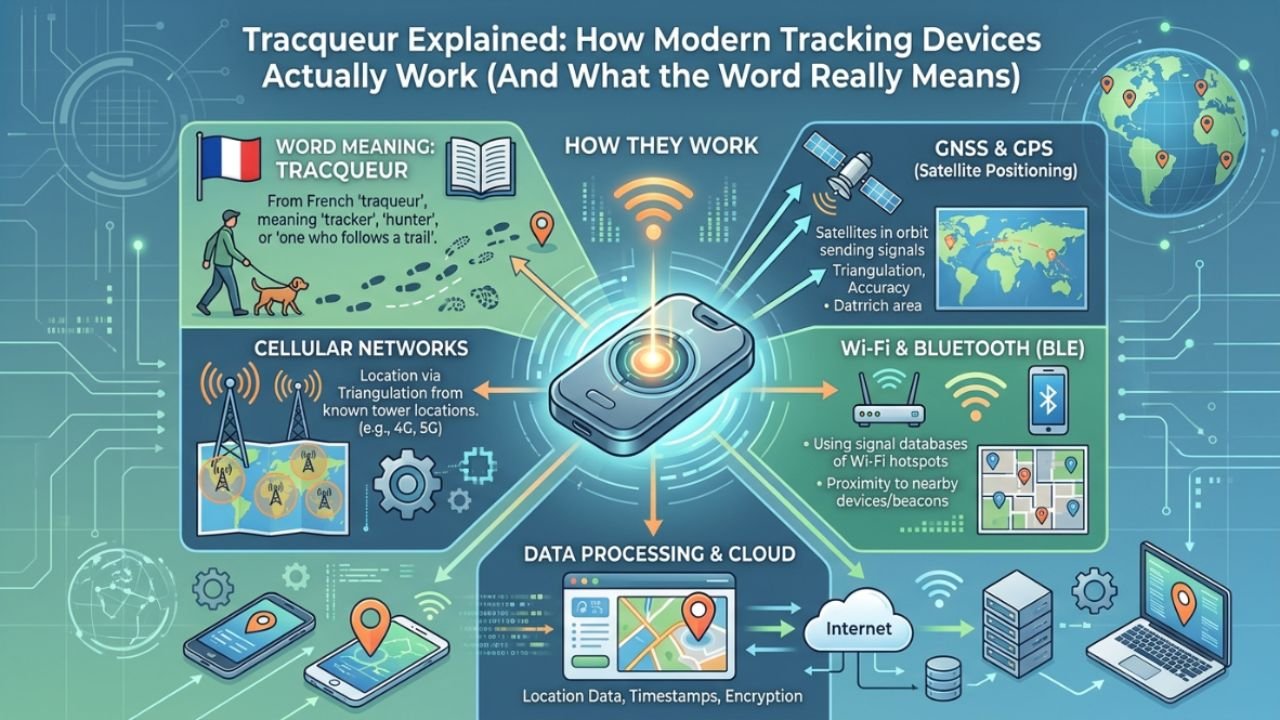
The word tracqueur comes directly from French, where it functions as the equivalent of the English noun “tracker” — something that follows, traces, or monitors movement. In English-language tech content, it has been adopted as a general label for any device or system designed to locate, monitor, or record the position and activity of a person, animal, vehicle, or object.
It’s worth being clear about something here: a tracqueur is not one specific product or app. It’s a category name, similar to how “smartphone” describes an entire class of devices rather than a single brand. When people search for this term, they’re usually trying to understand tracking technology in general — how GPS trackers, Bluetooth tags, and fleet-monitoring tools work, what separates one type from another, and which kind actually solves their problem. That’s the gap this guide aims to close.
How Tracking Devices Actually Work
At a basic level, every tracking device follows the same three-step process, regardless of whether it’s tracking a car, a suitcase, or a dog collar.
Step 1: Position Detection
The device determines its own location using one or more positioning technologies. The most common is satellite-based positioning through the Global Positioning System, a network of satellites that allows compatible receivers to calculate their location anywhere on Earth with strong accuracy. The U.S. government maintains detailed technical documentation on how this satellite network operates and is funded as a public service available to civilian devices worldwide.
Step 2: Data Transmission
Once the device knows where it is, it needs to send that information somewhere useful. This typically happens through one of three channels: cellular networks (using a SIM card, similar to a mobile phone), Wi-Fi networks, or short-range Bluetooth signals that relay data through nearby smartphones.
Step 3: Display and Alerts
The transmitted data lands on a server, and a companion app pulls that information to show a pin on a map, a movement history, or a real-time alert. Many modern systems also layer on extra features such as geofencing (an alert when a device enters or leaves a defined area), speed monitoring, and battery-life warnings.
The technology choice in Step 2 is what creates the biggest practical difference between tracking devices, and it’s the detail most buying guides skip over.
The Three Main Categories of Tracking Devices
GPS-and-Cellular Trackers
These are the most capable type. They combine satellite positioning with a built-in cellular connection, meaning the device can report its location from almost anywhere — a highway, a forest trail, a different country — without relying on a nearby phone. This is the technology used in vehicle anti-theft systems, fleet management platforms, and standalone pet trackers that work even when your dog wanders far from home.
The trade-off is cost and power consumption. Cellular connectivity requires a data plan (usually a small monthly or annual fee) and drains battery faster than other methods, which is why GPS-cellular trackers for pets and luggage often need recharging every few days to a couple of weeks depending on usage settings.
Bluetooth Trackers
Bluetooth-based finders, the category popularized by tags you clip onto keys, bags, or wallets, work differently. Rather than constantly broadcasting their own location via satellite, they emit a short-range Bluetooth signal that any compatible smartphone in the vicinity can detect anonymously and relay to the owner’s account. This crowdsourced network is what lets you “find” an item even when you’re not near it — as long as someone else’s phone passes by.
The upside is battery life measured in months or years rather than days, since Bluetooth radio uses far less power than GPS-cellular. The downside is that these tags are only as useful as the network density around them; in a remote area with few smartphones nearby, a Bluetooth tag effectively goes dark. The Bluetooth Special Interest Group, which oversees the wireless standard itself, publishes technical overviews explaining why this short-range, low-power approach works the way it does.
Wi-Fi and Hybrid Trackers
A smaller category of devices uses Wi-Fi network detection to estimate location, often as a backup when GPS signal is weak (such as indoors or in dense urban areas where satellite signals bounce off buildings). Most consumer devices today are actually hybrids, switching between GPS, Wi-Fi, and cellular or Bluetooth depending on what’s available, which is why your phone can still show a rough location even inside a shopping mall.
Common Real-World Uses
Vehicle Security and Fleet Management
This is one of the longest-established uses of tracking technology. Hidden GPS units installed in vehicles allow owners to monitor location continuously and, in the case of theft, provide law enforcement with a real-time recovery path. Businesses running delivery fleets use the same underlying technology at scale to monitor driver routes, reduce idle time, and lower fuel costs through better route planning.
Pet Recovery
A collar-mounted tracker with cellular connectivity means that if a dog or cat slips out of a yard, the owner can see a live map location rather than walking the neighborhood calling its name. Some models also track activity levels, which veterinarians sometimes use as a secondary health indicator.
Personal Item Recovery
Bluetooth tags attached to keys, wallets, backpacks, or luggage solve the “I can’t find it in my own house” problem far more often than the “it was stolen in another city” problem — an important distinction when deciding whether you need a Bluetooth tag or a GPS-cellular device.
Family Safety and Elder Care
Wearable trackers designed for children or elderly family members combine location sharing with features like SOS buttons and safe-zone alerts, giving caregivers peace of mind without requiring the wearer to carry a full smartphone.
Logistics and Supply Chain
At an industrial scale, tracking devices attached to shipping containers, pallets, or high-value cargo allow companies to monitor location, temperature, and handling conditions throughout a journey — critical for goods like pharmaceuticals or fresh produce where a broken cold chain can ruin an entire shipment.
What These Devices Are Genuinely Good At — and Where They Fall Short
It’s tempting for product guides to present tracking devices as a flawless solution, but a fair assessment means being honest about the limits too.
Where they excel: Recovering items left behind in predictable places (a Bluetooth tag left at a friend’s house, for example), monitoring vehicles or assets that travel through areas with good cellular coverage, and giving caregivers a general sense of where a person or pet is without constant check-in calls.
Where they struggle: Battery life remains the single biggest practical limitation for GPS-cellular devices — a tracker that needs charging every 48 hours is far less useful for a pet that might be missing for days. Signal reliability also drops significantly in dense urban canyons, underground spaces, and remote rural areas with poor cellular coverage. Bluetooth trackers are entirely dependent on network density, meaning their usefulness varies dramatically by region.
Privacy: The Part Most Guides Skip
There’s a privacy dimension that deserves real attention. The same technology that helps you find your luggage can, if misused, be used to monitor a person without their knowledge or consent. This concern has drawn regulatory attention: in late 2024, the Federal Trade Commission settled several enforcement actions against companies that collected and sold consumers’ precise location data without adequate consent, and published guidance for businesses on building transparent, consent-based location data practices.
For individual buyers, the practical takeaway is to choose devices from manufacturers with a published privacy policy, built-in anti-stalking detection (most major Bluetooth tag platforms now alert a phone if an unknown tag is traveling with it), and clear data retention practices.
How to Choose the Right Tracking Device
Rather than starting with brand names, start with the question: what am I actually trying to solve?
“I keep losing my keys, wallet, or bag around the house or in familiar places.”
A Bluetooth tag is almost always the right — and cheapest — answer. Battery life will last well over a year, and the crowdsourced finding network handles most realistic scenarios.
“I need to know where my car, van, or pet is at all times, including far from home.”
You need a GPS-cellular device, and you should factor in the ongoing data subscription cost as part of the total price, not just the hardware cost.
“I manage multiple vehicles or shipments and need reporting, not just a map pin.”
You’re looking at a fleet or logistics platform rather than a consumer gadget — these typically bundle hardware with a dashboard that tracks fuel use, driver behavior, and maintenance schedules.
Features Worth Checking Regardless of Category
- Geofencing alerts, so you’re notified automatically rather than having to check the app constantly
- Water resistance rating if the device will be outdoors or attached to a pet
- Size and weight of the unit relative to what it’s attached to
- What happens to your location history data — how long it’s stored and whether it’s shared with third parties
Setting Up a Tracking Device: What to Expect
Most consumer tracking devices follow a similar setup pattern. First, download the manufacturer’s app and create an account — this is where you’ll later view maps, alerts, and history. Second, pair the device, either over Bluetooth for short-range tags or by activating the built-in SIM for GPS-cellular units (some come pre-activated, others require choosing a data plan during setup).
Third, place or attach the device correctly. For vehicles, hidden placement near metal-free areas of the car body improves GPS reception, since metal can block satellite signals. For pet collars, manufacturers usually recommend a snug but comfortable fit so the unit doesn’t shift position and drain the battery faster through constant movement.
Finally, configure alerts before you actually need them. Setting up a geofence around your home, workplace, or a pet’s usual yard takes a few minutes and is the feature most owners forget to enable — only to wish they had it the day something actually goes missing.
The Future of Tracking Technology
Tracking hardware is steadily converging with everyday devices rather than remaining standalone gadgets. Newer smartphones and wearables increasingly include ultra-wideband chips alongside Bluetooth, allowing for far more precise short-range location (“which drawer” rather than “which room”). On the cellular side, low-power wide-area network standards are extending battery life for asset trackers from weeks to potentially years, which matters most for industrial and logistics use cases where devices may sit on a single battery for an entire shipping cycle.
For everyday users, the practical shift to watch is integration: rather than juggling separate apps for a car tracker, a pet tracker, and a luggage tag, ecosystems are moving toward a single dashboard that shows everything that matters to one household or business — provided, of course, that the privacy and consent questions raised above are handled responsibly by the platforms building these systems.
Frequently Asked Questions
Is a tracqueur the same as a GPS tracker?
Not exactly. A GPS tracker is one specific type of tracqueur — the broader term covers any tracking device or system, including Bluetooth tags and Wi-Fi-based locators that don’t use satellite positioning at all.
Do tracking devices work without internet or cellular service?
Bluetooth tags can still broadcast a signal without internet, but that signal only becomes useful once a nearby smartphone with internet access detects it and relays the location. GPS-cellular devices need an active data connection to transmit location in real time.
How long does the battery last on a tracking device?
It depends heavily on the technology. Bluetooth tags commonly last close to a year on a single battery. GPS-cellular devices vary widely, from a few days to a few weeks, depending on how frequently they report location and whether features like motion alerts are active.
Are tracking devices legal to use?
Tracking your own belongings, vehicle, or pet is generally legal. Tracking another person without their knowledge or consent raises significant legal and ethical concerns and, depending on jurisdiction, can violate stalking and privacy laws — this is why most major manufacturers now include anti-stalking detection features.
Final Thoughts
A tracqueur, at its core, is simply a tool for answering one question: where is it right now? Whether that “it” is a set of car keys, a delivery van, or a family pet determines which type of device actually makes sense — and the right choice usually comes down to matching the technology (Bluetooth, GPS-cellular, or hybrid) to how far the tracked item realistically travels and how often you need to check on it. Start with that question, and the rest of the decision becomes much simpler.