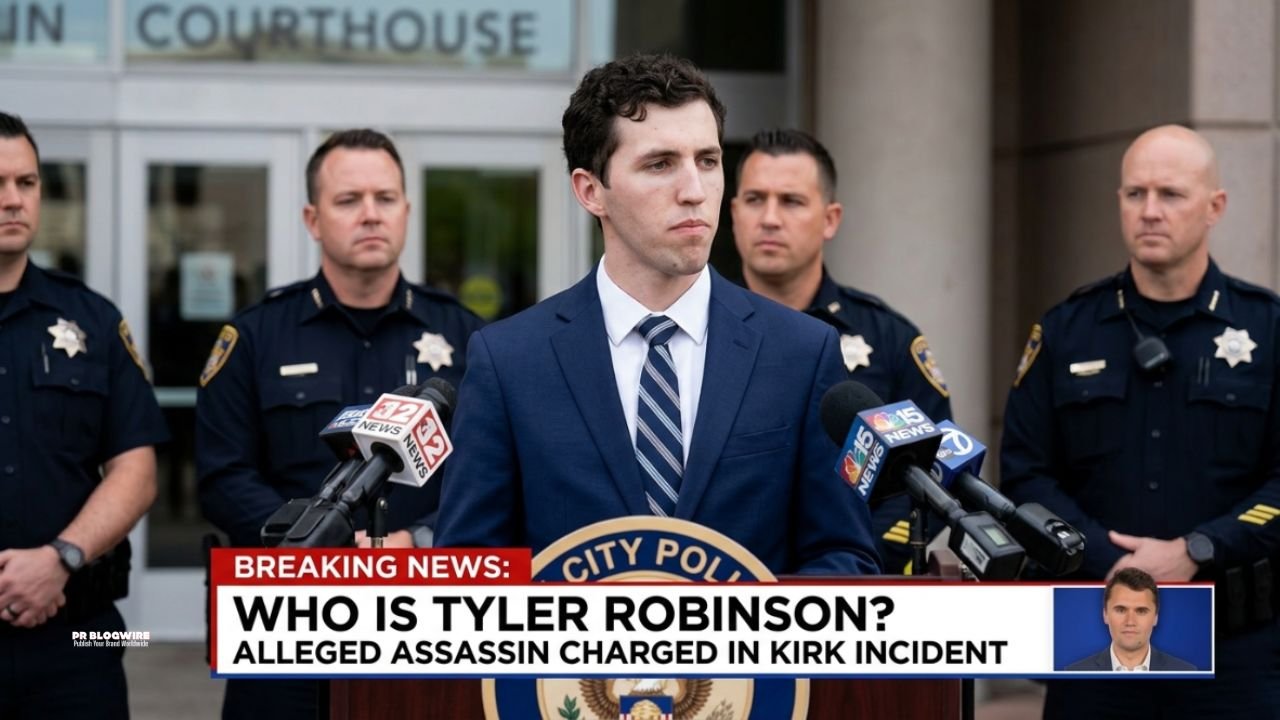
On the morning of September 10, 2025, Tyler Robinson drove three hours from his home in southern Utah to Utah Valley University in Orem, carrying a high-powered bolt-action rifle. According to prosecutors, he positioned himself on a rooftop, waited for the outdoor event to begin, and allegedly fired a fatal shot at Charlie Kirk — the founder of Turning Point USA and one of the most prominent conservative voices in America. Kirk was 31 years old, a husband and father of two.
Robinson was arrested less than 33 hours later in Washington County, Utah — turned in, remarkably, by his own father. The speed of the arrest was hailed as a law enforcement success. The storm that followed — over Tyler Robinson’s politics, his online life, his radicalization, and what it all means for American democracy — has not stopped since.
This article is a factual, evidence-based breakdown of everything currently known about Tyler Robinson’s political views, voter registration, family background, online activity, and the legal proceedings that have followed. It is not an advocacy piece for any political position. It is an attempt to answer the question that millions of Americans and global observers have asked: What did Tyler Robinson actually believe — and why does it matter?
Quick Facts: Tyler Robinson
- Age: 22 (at time of arrest, September 2025)
- Hometown: Washington County, southern Utah
- Education: Former scholarship student at Utah State University (one semester, 2021); later dropped out
- Party Registration: Unaffiliated — no declared party; voter registration listed as “inactive”
- Alleged Crime: First-degree/aggravated murder of Charlie Kirk at Utah Valley University, Sept. 10, 2025
- Charged with: Capital murder (death penalty eligible)
- Status (as of 2026): In custody; legal proceedings ongoing
Was Tyler Robinson a Republican or a Democrat?
This is the question that dominated American media for weeks after the shooting — and the answer is neither simple nor satisfying for those seeking a clean partisan narrative.
Public voter registration records confirm that Tyler Robinson registered to vote in 2021 but did not declare a party affiliation. He is listed as an independent, unaffiliated voter. According to the Washington County Clerk’s Office, Robinson never actually cast a ballot despite being a registered voter. His registration was eventually labeled “inactive.”
In the immediate aftermath of the shooting, social media users on both sides rushed to claim or disown Robinson. Conservative commentators pointed to anti-fascist symbols found at the scene. Progressive voices noted that several family members described themselves as lifelong Republicans and Trump supporters. Neither framing tells the complete story.
Voter Record Summary: Tyler Robinson registered to vote in 2021 with no declared party affiliation. The Washington County Clerk confirmed he never cast a ballot. His voter registration status was listed as “inactive” at the time of his arrest.
Robinson’s grandmother, Debbie, told reporters that virtually the entire Robinson family identified as Republican. “Most of my family members are Republican. I don’t know any single one who’s a Democrat,” she said, according to Time magazine. She also described Tyler as “the shyest person” who “never, ever spoke politics” to her at all.
What investigators, family members, and prosecutors agree on is that Robinson’s politics shifted noticeably in the period following his departure from Utah State University — a shift that appears to have accelerated in the final year before the shooting.
The Political Shift: How Tyler Robinson’s Views Changed
According to court documents, family statements, and investigators’ accounts, Tyler Robinson underwent a significant ideological transformation in the years between 2021 and 2025. This transition is central to understanding the context — and the alleged motive — behind the shooting.
From Scholarship Student to Political Radicalization
Robinson was described by those who knew him earlier in life as a high-achieving, quiet young man. He received an academic scholarship to Utah State University and enrolled in engineering studies. He attended for one semester in 2021 before dropping out. This appears to be a turning point.
Utah Governor Spencer Cox told NBC’s Meet the Press that family and friends described Robinson’s politics as having shifted leftward after dropping out of Utah State and moving back to southern Utah. “It seemed to happen kind of after that,” Cox said. He also noted that Robinson spent a significant amount of time in what officials described as the “dark corners of the internet.”
Robinson’s mother, speaking with investigators and cited in court documents published by Fox News, said her son had “become more political” in the final year before the shooting, supporting what she described as “pro-gay and trans rights” positions — a significant departure from the conservative household he grew up in. She recounted heated arguments between Robinson and his father, who held opposing views.
The Family Dinner Conversation
One of the most telling details emerged from a family member’s conversation with investigators. According to Governor Cox, during a family dinner, Robinson mentioned that Charlie Kirk was coming to Utah Valley University and expressed strong disapproval. He told family members he believed Kirk “spreads too much hate,” according to court documents cited in multiple media reports including NBC News.
This dinner conversation later proved significant. It established, in the eyes of prosecutors, a pre-meditated intent linked to Kirk’s political views. Court filings allege Robinson intentionally targeted Kirk “because of his political expression.”
What the Evidence at the Scene Revealed About Robinson’s Politics
The physical evidence left behind by Robinson added further — if contested — layers to the political picture. Investigators recovered a high-powered bolt-action rifle from a wooded area near the campus. Several bullet casings, both fired and unfired, had been deliberately engraved with inscriptions.
The Bullet Casing Inscriptions
Governor Cox said one casing was inscribed with the phrase “Hey fascist! Catch!” — a message Cox described as speaking “for itself.” Other casings contained references to the video game Helldivers 2 and lyrics from the Italian anti-fascist song Bella Ciao, which has also been popularized in recent years by online gaming communities through games like Far Cry 6.
This is where interpretation became genuinely contested. Bella Ciao carries undeniable anti-fascist historical connotations dating back to the Italian resistance against Nazi and Fascist forces in World War II. However, as CNN and other outlets noted, the song has been used prolifically in online gaming culture and popular entertainment without necessarily carrying a political agenda. The irony-saturated world of online meme culture makes clean interpretation difficult.
Some observers attempted to link Robinson to the far-right Groyper movement — a network of white nationalists associated with internet personality Nick Fuentes who had long been at odds with Charlie Kirk’s brand of mainstream conservatism. These claims were widely disputed and ultimately unsupported by investigators.
FBI Assessment: FBI Co-Deputy Director Dan Bongino said in public statements that Robinson appeared to have exhibited “multiple warning signs” and described an “obsession” with Charlie Kirk based on his digital footprint. He characterized the attack as “clearly an ideologically motivated attack.”
Tyler Robinson’s Online World and the Radicalization Question
Perhaps the most significant political story embedded within the Tyler Robinson case is not about party labels or voter cards — it is about the role of digital platforms in shaping, accelerating, and potentially weaponizing political identity in young people.
Investigators found that Robinson was “terminally online” — a contemporary term for individuals whose social reality and worldview are shaped primarily by internet communities rather than real-world relationships. He participated in gaming forums, online chat groups, and communities that blended political commentary, internet humor, and increasingly extreme viewpoints.
The charging documents described Robinson as someone who had been “radicalized online,” and prosecutors alleged he had communicated with his partner ahead of the shooting. In a text message to his partner, Robinson allegedly wrote that he had “had enough of his hatred,” referring to Kirk. He also texted: “Some hate can’t be negotiated out.”
These communications, obtained by law enforcement and cited in court filings reported by Time magazine, led Congress to act. House Oversight Committee Chairman James Comer invited the CEOs of Discord, Steam, Twitch, and Reddit to testify on the radicalization of online forum users, stating that Congress had a duty to examine how specific platforms may have contributed to politically motivated violence.
What Criminologists Say About Online Radicalization
Dr. James Fox, a criminologist at Northeastern University, spoke directly to the Robinson case shortly after the arrest. “We’re not talking about street crime,” Dr. Fox said. “We’re talking about something that’s ideological and you don’t have to be poor, you don’t have to be from a broken home to be driven by ideology.”
Fox noted that at 22 years old and as a college dropout, Robinson fits a pattern common in radicalization research: a young person experiencing a transitional identity crisis — the loss of an academic path, a scholarship, and a future he had imagined for himself — who finds purpose and belonging in increasingly extreme online communities.
Radicalization researchers have long documented this pipeline. The RAND Corporation and other institutions have published extensive research showing that online environments can accelerate belief radicalization in ways that face-to-face communities rarely replicate — precisely because of the algorithmic amplification of emotionally charged content, the anonymity that allows extreme ideas to circulate without social consequence, and the echo-chamber dynamics of platform design.
Tyler Robinson: A Timeline of the Political Narrative
The Political Fallout: What Robinson’s Case Did to American Politics
The shooting of Charlie Kirk did not occur in a political vacuum. It happened during a period of heightened political tension in the United States — a period marked by multiple assassination attempts on political figures, a deeply polarized media landscape, and growing concerns about the boundaries of political rhetoric.
The fallout from Robinson’s alleged actions reshaped policy and political discourse in measurable ways.
The Trump Administration’s Response
President Donald Trump, who had praised Kirk as instrumental in his 2024 electoral victory, condemned the shooting in the strongest terms. Within a week, on September 17, 2025, Trump announced he would formally designate antifa as a terrorist organization.
On September 25, 2025, Trump signed a national security memorandum directing the Department of Justice, FBI, and Joint Terrorism Task Force to prioritize what the document described as anti-fascist political violence. The memorandum controversially cited “indicators” of radicalization including “anti-capitalism, anti-Americanism, and hostility towards those who hold traditional American views” — language that civil liberties advocates warned was dangerously broad.
White House Deputy Chief of Staff Stephen Miller characterized the Kirk assassination as the product of an ideology “at war with family and nature” that “leads, always, inevitably and willfully, to violence.” He vowed to use law enforcement resources to “dismantle and take on” violent radical left organizations.
The Misinformation Problem
One of the underreported dimensions of the Tyler Robinson story is how badly the case was distorted by social media misinformation in real time. As documented by France 24 and fact-checking organizations, doctored images and misattributed symbols circulated across platforms — some attempting to portray Robinson as a leftist, others as a right-wing extremist. Both sets of claims were manufactured or decontextualized.
Fact-checkers at Factually.co and other outlets consistently noted that assertions about Robinson’s politics were “weaponized by both sides” and that the evidence supported only one conclusion: his politics were contested, evolving, and far more complex than any partisan label could contain.
What Robinson’s Case Reveals About Political Violence in America
Tyler Robinson’s alleged crime is not comprehensible as a standard political assassination in the historical sense — a calculated act by an ideologically coherent actor targeting a political leader for clear strategic reasons. What the evidence suggests is something arguably more troubling: a young man shaped by the irony-saturated, emotionally volatile ecosystems of the internet, who translated accumulated grievances and online radicalization into real-world violence.
Commentary published in City Journal described the phenomenon as a “left-wing terror memeplex” — a system where radicalized individuals absorb a loose constellation of anti-establishment ideas, anti-authority narratives, and grievance politics, and in rare cases, spin them into unpredictable violence.
Whether that framing is accurate or politically motivated is a legitimate debate. What is beyond debate is the trajectory: a 22-year-old, adrift after dropping out of university, who spent years in digital communities that blurred entertainment, irony, and political extremism, and who allegedly committed an act of political violence that shocked a nation already exhausted by political hostility.
The Pew Research Center has documented for years that Americans hold increasingly negative views of those on the opposite side of the political spectrum — not just disagreement, but contempt and fear. When political opponents are consistently framed as existential threats, in rhetoric from politicians and commentators alike, the psychological distance between anger and violence shrinks. Robinson’s case is one data point in that disturbing trend.
Frequently Asked Questions About Tyler Robinson’s Politics
Was Tyler Robinson a Democrat or a Republican?
Neither. Tyler Robinson registered to vote in 2021 with no declared party affiliation. He is listed as an unaffiliated, independent voter. The Washington County Clerk confirmed he never cast a ballot. His voter registration was labeled “inactive.”
Was Tyler Robinson part of Antifa?
No confirmed organizational membership has been established. Investigators pointed to anti-fascist symbols on bullet casings as potential evidence of ideological influence, but no formal Antifa membership or organizational connection has been publicly confirmed by law enforcement.
Why did Tyler Robinson allegedly target Charlie Kirk?
According to court documents and prosecutors, Robinson targeted Kirk “because of his political expression.” Robinson’s communications with his partner before the shooting indicate he had “had enough of his hatred,” referring to Kirk. Prosecutors allege the killing was politically motivated, though the full motive is still being examined at trial.
When did Tyler Robinson become political?
Family members and acquaintances told investigators that Robinson’s political views began shifting noticeably after he dropped out of Utah State University in 2021. The shift accelerated in 2024–2025, according to his mother’s statements to law enforcement.
Is Tyler Robinson’s trial ongoing?
As of mid-2026, Robinson remains in custody without bail. He faces capital murder charges — which carry the death penalty in Utah. Legal proceedings are ongoing. He has not cooperated with investigators, though family members and his partner have spoken with authorities.
How did Tyler Robinson get caught?
Robinson’s own father recognized him from surveillance images released by Utah authorities. He contacted the Washington County Sheriff’s Office, leading to Robinson’s arrest in St. George, Utah, within 33 hours of the shooting.
The Limits of Labels in an Age of Digital Radicalization
The story of Tyler Robinson’s politics is ultimately a story about the poverty of political labels when applied to a generation shaped not by party platforms or civic participation but by algorithms, meme culture, and online communities where meaning is routinely destabilized by irony.
He was not a registered Democrat. He was not a registered Republican. He was not an Antifa member with a card and a chapter. He was a 22-year-old from southern Utah with an academic scholarship he did not use, a family he was growing apart from, and an internet habit that, according to investigators, prosecutors, and family alike, took him somewhere very dark.
What Tyler Robinson’s alleged act of political violence leaves behind is not a clear ideological verdict — it is a series of urgent questions. About the role of platforms in amplifying extremism. About the emotional and social disconnection of young people in post-pandemic America. About the rhetoric of political leaders who consistently frame opponents as enemies worthy of hatred. And about where personal responsibility ends and systemic failure begins.
These are not comfortable questions. They do not have comfortable answers. But they are the right ones to ask — and they deserve more honest engagement than any political label can provide.
Sources & Further Reading
- ABC News — “Charlie Kirk killing: Suspect had ‘obsession’ with the conservative influencer, FBI says” (September 2025)
- NBC News — Live Coverage: Charlie Kirk Shooting Suspect Tyler Robinson in Custody (September 2025)
- CNN — “What we know about Tyler Robinson, the suspect in Charlie Kirk’s murder” (September 2025)
- CNN Politics — “Analysis: What we know — and don’t know — about what motivated Charlie Kirk’s assassination” (September 2025)
- Time Magazine — “Suspect in Charlie Kirk Killing Left Messages, But No Motive” (September 2025)
- Time Magazine — “Reddit and Twitch CEOs Called to Testify on Radicalization” (March 2026)
- The Week — “Is Tyler Robinson a Republican?” (September 2025)
- Hollywood Life — “Is Tyler Robinson a Republican or Democrat?” (September 2025)
- Fox News — “Mom of Charlie Kirk’s alleged assassin describes radical shift in last year” (September 2025)
- Northeastern University — Criminologist Dr. James Fox on Robinson Arrest (September 2025)
- Washington Post — “What Charlie Kirk’s alleged killer did in the days leading up to the shooting” (December 2025)
- Factually.co — Fact Check: Tyler Robinson’s Political Affiliation
- Wikipedia — Tyler James Robinson (updated 2026)
- PBS NewsHour — Capital Murder Charges Against Tyler Robinson (September 2025)
- RAND Corporation — Research on Radicalization
- Pew Research Center — Political Polarization in America