Haiti’s return to the FIFA World Cup was supposed to be an uninterrupted celebration. After 52 years away from football’s biggest stage, Les Grenadiers had earned their place at the 2026 tournament with a gritty CONCACAF qualifying campaign, finishing above favorites Honduras and Costa Rica. The kit chosen to mark this comeback was deeply intentional — a tribute to Haitian identity, the revolutionary spirit, and the foundational story of the world’s first Black republic.
Then FIFA stepped in.
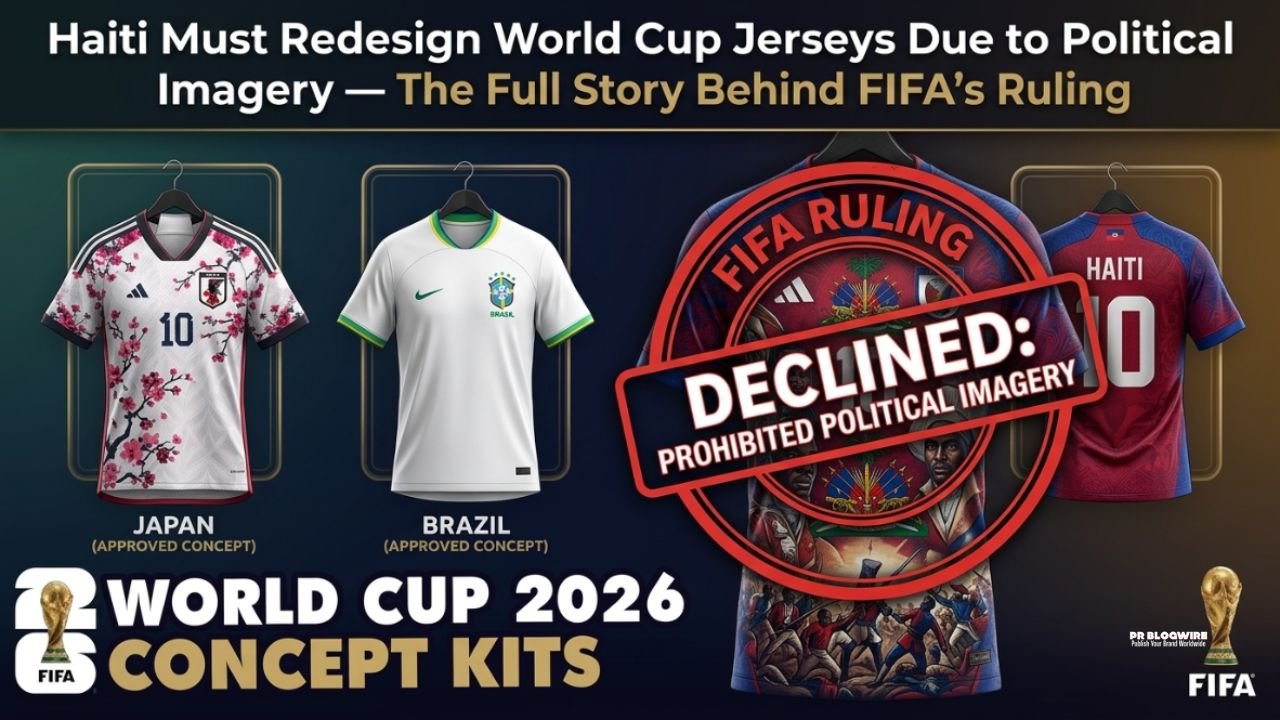
Haiti’s long-awaited return to the FIFA World Cup has been overshadowed by a last-minute row over its national team jersey, after the sport’s governing body ruled elements of the design breached rules on political messaging. Just days before their opening match, Haiti were told to alter their kits after FIFA raised concerns over artwork depicting the Battle of Vertières, a pivotal moment in the country’s fight for independence.
The result? Haiti must redesign World Cup jerseys due to political imagery — a ruling that has sparked one of the most emotionally charged debates in recent World Cup history.
This article covers every layer of the story: what was on the original jersey, why FIFA banned it, how manufacturer Saeta responded, the fascinating history behind the Polish flag on the kit, where to buy the official Haiti World Cup jersey, and what this entire episode reveals about FIFA’s complicated relationship with national identity.
What Was on Haiti’s Original 2026 World Cup Jersey?
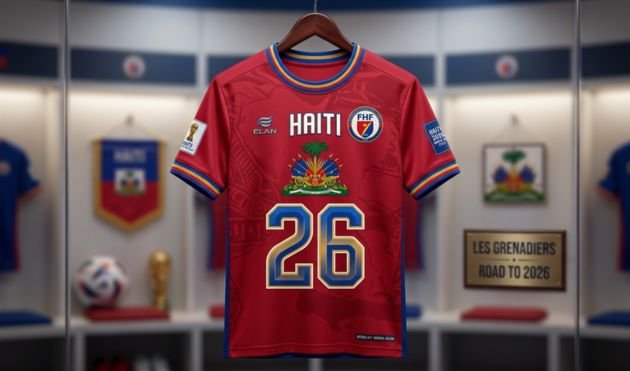
The original Haiti jersey for the 2026 FIFA World Cup was created by Saeta, the sportswear brand that made the jerseys for Haiti’s national soccer team. FIFA determined certain imagery could be interpreted as political under the organization’s equipment regulations.
The home kit was a rich, deep blue — rooted in the colors of the Haitian national flag — and it carried something extraordinary on the front: a vivid illustration of soldiers raising the Haitian flag, drawn directly from the imagery of the Battle of Vertières.
The contested imagery referenced the Battle of Vertières in 1803, one of the most significant events in Haitian history. The battle marked the decisive defeat of French forces and paved the way for Haiti’s independence in 1804, making it the first nation founded by formerly enslaved people after a successful revolution. For many Haitians, the battle is a symbol of national identity, resilience and liberation — which Saeta said was the intent behind incorporating the design into the jersey.
The jersey was worn publicly during Haiti’s pre-tournament warmup matches. Defender Jean-Kévin Duverne recently offered fans a glimpse of the updated blue kit, which no longer includes the battle artwork featured on the original version worn during recent warmup matches in South Florida. Forward Wilson Isidor was also photographed in the original design. Social media loved it. Then FIFA’s equipment approval process began.
The official Saeta jersey description captured the vision clearly: “More than two centuries ago, a nation was born. Today, a new era has begun. This is more than just a jersey — it is a tribute to the Haitian people.”
Why Did FIFA Force Haiti to Redesign the Jerseys?
Under rules adjudicated by FIFA, uniforms must not “contain any words, images, statements or relationship to messages that are political, religious or discriminatory, or personal slogans, statements or images of any kind.”
Under this regulation, FIFA’s approval body determined that the Battle of Vertières artwork — regardless of its historical or cultural significance to Haitians — fell within the definition of political imagery. The ruling came through during the pre-tournament approval process, days before Haiti’s opening match against Scotland on June 13, 2026.
Saeta confirmed the change in a statement posted on Instagram, following FIFA’s objection to an illustration of the Battle of Vertières in 1803, which secured Haiti’s independence, with the national flag embedded on the shirts worn by the players in two warm-up matches in the US state of Florida. Al Jazeera
Saeta made their position clear: “The final design presented by Saeta was intended as a tribute to the men and women who contribute every day to Haiti’s future and was not intended as a political statement.”
The Haitian Football Federation pushed back even harder. A spokesperson told The Athletic: “Following a misinterpretation, FIFA officials asked the federation to remove an image depicting Vertières and some independence heroes raising the Haitian flag. Vertières is the site of the last battle leading to our independence, fought on November 18, 1803. Ironically, the team qualified for the 2025 World Cup on November 18, 2025.”
That date — November 18 — is the same day Haiti secured their World Cup spot. The symbolism was not lost on Haitian fans anywhere in the world.
Haiti’s Double Rebuke — This Is Not the First Time in 2026
What makes the story of why Haiti must redesign World Cup jerseys due to political imagery even more significant is that it forms part of a pattern that has repeated twice within a single year.
Haiti has been forced to change the design of its World Cup jersey after it was deemed too political by FIFA just months after the Caribbean nation had to amend its Winter Olympic uniforms. Similarly, the International Olympic Committee required the removal of an image of Haitian founding father Toussaint Louverture from Haiti’s opening ceremony uniforms for the Milan Cortina Winter Games, ruling that it violated Olympic rules barring political symbolism.
Those Winter Olympics uniforms were designed by Italian-Haitian fashion designer Stella Jean. Jean came up with a creative solution: painting over the figure, leaving just a horse against the background of tropical foliage. The designs were so much in demand that Jean later created a production version featuring the original Louverture image.
Jean told The Athletic: “Either way, Haiti has to be setting a record: two rebukes from the highest international sports authorities in just a few months.”
For many observers, both rulings raised an uncomfortable question: when does a nation’s founding history become a “political statement” — and who gets to decide that?
The Polish Flag on Haiti’s World Cup Jersey — What Is the Real Story?
When Haiti’s jersey was first unveiled, sharp-eyed fans spotted something unexpected: a figure on the kit appearing to hold the Polish flag — a white and red horizontal bicolor. The reaction online ranged from confusion to viral curiosity. Was it a design error? Was Poland somehow involved in sponsoring Haiti’s kit?
The truth is far more historically compelling.
The Polish Legion and the Haitian Revolution
In 1802, Napoleon dispatched hundreds of Polish Legion soldiers to the island to quell the slave insurrection in Haiti. However, many Polish soldiers declined to fight against the Haitians fighting for freedom. They instead chose to join their ranks and fight alongside them against the French forces. After Haiti obtained independence in 1804, the country’s first leader, Jean-Jacques Dessalines, granted Poles citizenship. He referred to them in the constitution as the “Blacks of Europe.”
Saeta incorporated this extraordinary historical bond into the jersey as an intentional tribute — a recognition that Haiti’s story of liberation was shared, at a crucial moment, by people who had crossed an ocean and chose solidarity over orders.
Why the Flag Looks Like Poland’s
Because the Haitian national team’s home jersey is predominantly blue, the designers deliberately brightened the blue hue of the flag, which led to the flag on the jersey looking similar to a white and red color scheme in some photos.
Whether you read it as Haiti’s first national flag or as a tribute to the Polish legionnaires who stood with Haiti, the symbolism is entirely rooted in history — not geopolitics, not commercial partnership, not a design mistake.
Haiti’s 2026 World Cup Group, Schedule, and What They Face
The jersey controversy arrives at what should be a moment of pure national pride. Haiti has had to wait more than 50 years for a World Cup appearance. The nation made its only previous World Cup appearance in 1974 in the tournament held in West Germany. aol
Here is Haiti’s full Group C schedule for World Cup 2026:
| Date | Match | Venue |
|---|---|---|
| June 13, 2026 | Haiti vs. Scotland | Gillette Stadium, Foxborough, MA |
| June 19, 2026 | Haiti vs. Brazil | Lincoln Financial Field, Philadelphia |
| June 24, 2026 | Haiti vs. Morocco | Hard Rock Stadium, Miami Gardens, FL |
Despite the disruption, Haiti — drawn in a group with Scotland, Brazil and Morocco — will still make a historic return to soccer’s biggest stage, albeit in a kit that looks slightly different from what was originally intended.
Haiti, who are forced to play their games 500 miles away in Curaçao, put the finishing touches to a surprising qualifying campaign that saw them win Group C over favourites Honduras and Costa Rica. Their coach, Frenchman Sébastien Migné, has never visited Haiti itself due to ongoing unrest — an extraordinary circumstance that makes their World Cup qualification even more remarkable.
Where to Buy the Haiti World Cup 2026 Jersey
Demand for the Haiti 2026 World Cup jersey has been exceptional — driven by both the historic qualification and the global attention the jersey controversy generated. Here is where to find it:
Official Saeta Store: The primary source is SaetaUSA.com. The authentic Haiti jersey is created for those who recognize the value of a garment with identity, design, and character. It features two different fabrics: the front one with a mountain pattern and the back one characterized by its open weave structure with small holes that facilitate airflow, along with S-DRIED quick-dry technology.
Sizing Note: Men’s model wears size M. For women, Saeta recommends ordering one size down from the men’s fit.
Which Version Are You Getting? The version currently sold publicly is the redesigned kit — the one cleared by FIFA for the tournament, without the Battle of Vertières battle artwork. If you encounter sellers claiming to offer the “original” version with the battle scene, verify the source carefully.
Price and Availability: Given the surge in demand following the qualification story and the jersey controversy, availability may be limited. Ordering directly from Saeta is the most reliable route.
FIFA’s Political Imagery Rules — Where They Protect and Where They Fall Short
FIFA’s equipment regulations exist to keep international tournaments focused on football rather than national propaganda, ideological campaigns, or divisive messaging. That is a legitimate goal. Keeping the World Cup neutral protects players, fans, and host nations.
But the rules, as applied to Haiti, reveal significant gaps.
FIFA enforces strict rules that prohibit political or ideological messaging on team kits during international competitions. Those rules were written with a particular kind of political content in mind — current partisan messaging, government slogans, religious declarations. Applying them to a 220-year-old battle that is universally taught as Haitian national history stretches the regulation far beyond its intended purpose.
There is a meaningful difference between a jersey that carries a party slogan and one that depicts the founding moment of a nation. Critics argue — and many sports commentators have agreed in the days since the ruling — that FIFA’s approval process lacks the cultural and historical literacy needed to make that distinction consistently.
The late change has added to a series of off-field controversies surrounding the 2026 tournament, which has already faced scrutiny over travel, visas and security issues involving teams and officials. The Haiti jersey ruling, coming on top of the IOC’s Winter Olympics decision, has made both organizations targets of pointed criticism from human rights advocates, diaspora communities, and football commentators worldwide.
Saeta — The Colombian Brand Behind Haiti’s Historic Kit
Most fans associate World Cup kits with Nike, Adidas, or Puma. Saeta occupies different territory — a Colombian sportswear brand building its reputation on exactly the kind of identity-driven design that the Haiti jersey represents.
Their philosophy, as expressed through the Haiti kit, treats the jersey as a cultural artifact first and a performance garment second. The dual-fabric construction, the mountain-pattern front panel, the quick-dry technology — all of that is present. But the visual centerpiece was always meant to be the story: the Haitian Revolution, the first independence, the soldiers who gave Haiti its identity.
When FIFA stripped that story from the front of the jersey, it inadvertently handed Saeta the biggest press coverage the brand has ever received. The original Haiti 2026 kit generated coverage from ESPN, Newsweek, PBS NewsHour, Al Jazeera, Yahoo Sports, and Complex — reach no sportswear marketing campaign could have manufactured.
All World Cup Jerseys 2026 — And Why Haiti’s Stands Apart
Across the 48-team field at the 2026 FIFA World Cup, kit design has emerged as one of the most culturally resonant pre-tournament stories. Adidas released home and away kits for 25 national federations. Nike unveiled several others. Each kit tells its own story of national identity and commercial partnership.
But among all world cup jerseys 2026, Haiti’s has generated the most intense global conversation — and not because of its colors or its technical specifications. It generated conversation because of what it tried to say, what FIFA would not allow it to say, and the story that erupted in the space between those two positions.
South Africa’s 2026 kit, for example, was praised for connecting back to their 2010 World Cup aesthetic. Other nations used their kits to celebrate cultural patterns, regional art traditions, or historical color schemes. None attracted the depth of reaction that Haiti’s Saeta design did.
That reaction — critical, emotional, historically informed — reflects something real: a global audience that wants football to carry meaning beyond the scoreline, and that sees in Haiti’s story a mirror of larger questions about who controls national narrative on the international stage.
Frequently Asked Questions
Why did Haiti have to redesign their World Cup jerseys?
FIFA ruled that Haiti’s original 2026 World Cup jersey violated equipment regulations because it depicted the Battle of Vertières — the decisive 1803 battle that led to Haitian independence — and classified this as political imagery under tournament rules. Saeta and the Haitian Football Federation both disputed the characterization, calling it a misinterpretation of cultural heritage.
Who makes Haiti’s 2026 World Cup soccer jersey?
Haiti’s 2026 World Cup jersey is made by Saeta, a Colombian sportswear brand. Their official store is at saeta.us. The brand is known for design-forward kits that center national storytelling.
Why is there a Polish flag on Haiti’s World Cup jersey?
The figure holding the Polish flag is a tribute to Polish Legion soldiers who, in 1802, refused Napoleon’s orders to fight against Haitian freedom fighters and instead joined their cause. After Haitian independence, founding leader Jean-Jacques Dessalines granted these soldiers citizenship and called them “the Blacks of Europe.” Saeta included this detail as a historical tribute to the Haiti-Poland bond forged during the revolution.
Where can I buy the Haiti World Cup 2026 jersey?
The official Haiti 2026 World Cup jersey by Saeta is available at SaetaUSA.com. The version currently being sold is the redesigned kit cleared by FIFA for tournament use.
Is this Haiti’s first World Cup in many years?
Yes. The team’s qualification ended a 52-year World Cup drought and sparked a surge in demand for Haiti jerseys among supporters both on the island and throughout the diaspora.
Has Haiti’s sports uniform been banned before?
Yes — twice in the same year. The IOC required the removal of a Toussaint Louverture image from Haiti’s 2026 Winter Olympics uniforms earlier in 2026, making the FIFA World Cup jersey ruling Haiti’s second forced uniform redesign by a major international sports body within months.
When History Becomes “Political”
Haiti must redesign World Cup jerseys due to political imagery — that is the official ruling, and it stands. Les Grenadiers will take the field against Scotland on June 13 in a modified kit, without the soldiers of Vertières on the chest, without the visual declaration that their participation in this tournament is connected to 220 years of struggle and survival.
But the story of the original jersey will not stay off the pitch. It has already traveled further than any jersey design normally does — to front pages, to opinion columns, to conversations in Haitian diaspora communities from Miami to Montreal. In that sense, FIFA’s ban may have achieved the opposite of what it intended. Rather than keeping history invisible, it made Haiti’s history unavoidable.
The Battle of Vertières was fought on November 18, 1803. Haiti qualified for the World Cup on November 18, 2025. Les Grenadiers are back. And the world is paying attention — not just to the football.